
Comhad Uimh. 2
Newsletter Archives




Nuachtán No.2 January/Eanáir 1997
Data Analysis
Over the previous year we have been busy extracting data from the indexes of Births, Deaths and Marriages for England and Wales from the Central registrars office at St. Catherine's House in London.
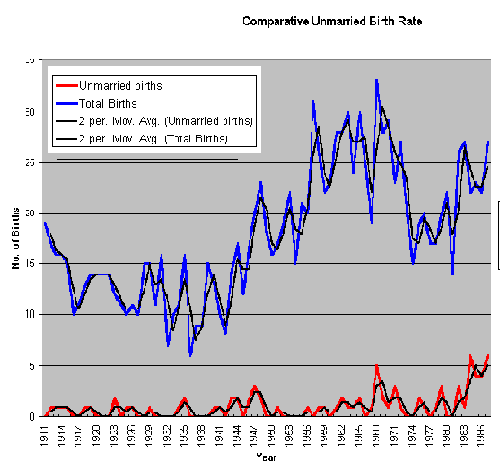
Currently we have extracted the Births records from June 1837 to December 1987. Inclusive of parents the total number of individuals amounts to 3,770, with total births of 2,028. Certain interesting observations can be made from the data.
Firstly, the total number of births in England and Wales per year grew from just 2 per annum in 1838 to 27 by 1987 . Contrasting these births statistics for England and Wales with Irish historical records, gives an interesting insight into Irish emigration to England and Wales. Robert E Matheson in his report, "Special Report on the Surnames in Ireland with notes as to the numerical strength, derivation, ethnology and distribution published in 1894 and based on the Irish census results of 1891, gives the number of births of clan members in Ireland in 1891 as 21. With the current Irish population marginally less than in 1891 and modern family size being lower, we can summize that based on the number of births per year, the Ó Maelearcaidh clan population numbers in England and Wales has probably become equal to that in Ireland.
We can also summize that as the current population of Ireland as a whole is just over 5 million, then based on our clan statistics for England and Wales, it would suggest a current Irish element in England and Wales of just over 5 million. Independent demographic estimates of the Irish in England and Wales vary from 5 to 10 million. If the experience of our clan are a test of those projections then it would suggest that the Irish element in England and Wales to be closer to 5 million rather than 10 million.
It is very early to extrapolate too much from this initial data however we might venture a guesstimate of the total clan births since 1838. Traditionally some 50 million US Americans claim Irish descent. This view based on the statistics appears high. A more realistic figure might be 10-15 million Americans of Irish descent. Irish also emigrated to Canada and Argentina, where they may collectively constitute a further 1 million of Irish descent. Then we need to take into account Australia, New Zealand and South Africa where perhaps a further 2 million Irish settled. Taking other European, South American and Asiatic countries into account there may be a further million Irish emigrants. This would give us a world wide Irish diaspore of some 20 million. Based on our data that is the equivalent of total birth records over the period from 1837 to 1987 of 12,000 approximately. Extrapolating this to its extreme and based on an average life-span of 70 years this would give a current worldwide clan population of 6,000 estimate.
So there we have it our first view of the clan size. In time we shall be able to establish the figures on a more scientific basis, however it is nice to play with the data that is to hand.
One rather surprising result, as will be readily noted from the graph below, is the decline in increase in the birth rate from the early 1960's, followed by a collapse in clan births in 1971. This may be the impact of family planning, however in the 1970's there were increasing economic pressures. The data shows that the modern family size in Britain is noticeable lower than previously, which also relates to the increasing use of contraception and the Abortion Act of 1967. The statistics show a stabalisation in the birth rate in the mid 1980's, and even record a noticeable increase.
Other population trends can also be noted. The Irish have been known for their wanderlust. From the data one notes that their births in England and Wales in the pre and post famine period were predominantly in the County of Lancashire in the North of England, a county with close communications to Ireland (Via the port of Liverpool) and with a long established Irish communities. In the mid 19th century Lancashire was the major hub of Britain's industrial revolution. Hence there was a demand for workers, which would have attracted poor Irish peasants, irrespective of which port they arrived in Britain.
Looking at the data however, it also becomes clear that though the Irish may have travelled extensively for work, once married with family then they became settled. In the early 19th century this settlement was mainly in the cotton towns of Lancashire such as Liverpool, Manchester, Preston etc. As industrial demands changed, canals were developed and railways cut so that latter arrivals moved into Yorkshire where the woolen, clothing and coal industries were rapidly expanding. Lesser numbers moved further into the North Eastern Counties of Northumberland and Durham as coal, shipbuilding industries developed . This pattern of industrial progress in England resulted in concentrations of the Irish population in other major Northern English towns such as Huddersfield, Bradford, Leeds and Newcastle. Many of these English towns ended up with Irish ghettoes, which would have been unsafe to resident and visitor alike.
This pattern of settlement only began to breakup as the 20th century progressed. The statistics show clan members gradually moving into the English midlands and the South of England, including London. In line with this trend was a dispersal of the Irish into the suburbs and the countryside. One detects that second and third generation Irish becoming integrated into English life and moving outside purely Irish circles. The big social change however appears to be the second world war, when people appear to be dramatically on the move. Family births suddenly are nolonger associated with just one location. This social instability arising from the war effort, restructured peoples lives and was a foretaste of the future. Despite post war births again returning to a more stable situation, they did not completely revert to the old certainties. The war appears to have conditioned part of the population to accept that, at times it was correct to relocate to find work, even with a settled family. This trend was very slow to take root, however again from the statistics it's clear that the revolution of cheap motoring, availability of free university education and social upheaval of the 1960's, suddenly brought about a dramatic change in the way people related to family, and work.
For the Irish one would also have to say that the immigrant institutions, background and religion lessened the impact of social change through the 19th and much of the 20th centuries. From the onset of the 1960's we see a mirroring of the major changes affecting British society. As an example, the incidence of clan illegitimacy had been increasing steadily through the 1950's until 1971. Despite this it was still relatively insignificant at around 16% of births. By the 1980's it is clear from the data that an increasing numbers of clan births are outside marriage, whether illegitimate births, or to couples who have chosen not to marry. This reflects the decline in religious attendance, the more relaxed view of illegitimacy and decline in relative importance of the institution of marriage. To put this in context the incidence of extra marital clan births by 1987 amounts to some 20% per as opposed to a British average of 35%.
England & Wales Births 1911 to 1986
Over the next six months we will have to recheck our extract of data for accuracy before we progress to extracting the deaths for England and Wales 1838-1987. We will also update the births since the last extract. Out aim is to update all such records to the year 2000, which will then be our starting point base line.
Simply obtaining data from the indexes is not really sufficient to piece together family trees. We need to gradually acquire the actual Certificates of birth, death and marriage. As mentioned in other Web Pages this will be a very costly exercise. Again we appeal to the generosity of readers of the clan site who would like to assist. If you are able to make a donation then building of the clan tree can proceed at a much faster pace.
Origins
Enough of the commercials, what else have we been up to. Well, we have delved into the murky world of derivation of the name. In this we came across a rather interesting if somewhat controversial book called "Ten thousand Saints a study in Irish and European Origins" by Hubert Butler, printed by the Wellbrook Press of Kilkenny in 1972. The book is a study into the derivation of name types. At page 240 the author notes that there are three main concentrations in Ireland of "Mael" names, the Conmaicne region of Leitrim and Longford, the counties of Mayo and Sligo and the Uí Mail region of Wicklow. Though he adds a rider that there is also some evidence for concentrations in Wexford and Leix.
Hubert Butler casts doubt on the understanding that maol=bald, and that this then signifies a disciple. He contends that Mael was primarily a tribal word. As evidence for this he notes that in Leitrim and Sligo there are 20 Mael names, most of which have no corresponding saint's name. The author suggests that Mael=Mil, that is in English Milesian, being a name the Gael gave to themselves, in the sense of a son/daughter of Milo, the historical Gaelic king who led the Irish from Spain to settle in Ireland. It has to be stressed that this is not the accepted view of 99.9% of those in the field of Irish Genealogy.
His further contention is that the second part of the Mael names signifies specific tribes of the Gael. Hence in our case he is suggesting the name signifies a Milesian tribe called the Ercaidh. Rather interestingly he also notes that one major constituent of the Gael are the Uí Erca who were a tribe in Kildare.
The existence of the Erca people as a group in Ireland was also reflected in the fairly common use of the name Erc by both men and women. Hubert Butler notes that there were several Erc's amongst the early Irish saints. For example there was St Erc and/or St Ercaid who was a daughter of Daire, who gave the site of Armagh to St. Patrick. As a disciple of St. Patrick, she acted as his embroideress. Rather interestingly Butler notes that St Aengus the Culdee reported that St Columba's embroideress was called Ercnat, "because ercaidh was an old word for embroidery". This gives yet another avenue for research, but just indicates how common was the name Erc. As an addendum St Aengus also says poor St. Ercait died of carnal love for St. Benen, which just shows that the permissive age is nothing new.
The identity of St. Erc therefore in early Irish society may well have merged not just the several St's Erc, male and female but also other Erc hero's. Apart from the various St's. Erc, there was also Erc the father of Daire, who was a profound force in the expanded power of the widespread Daire tribe of Ulster. The Erca tribe itself must have been one of the most important in Ireland as St Patrick himself was constantly either cursing or consecrating them. Hubert Butler is of the opinion that they exercised dominion of parts of both Ireland and Britain.
He does point out however that the most significant of all the Erc's is the blessed Erc, mythological/historical daughter and mother of Irish and Scottish kings. She gave her name to Crich mac nErci in Ulster. In early Irish histories it was said that her first husband Sarran "had dominion over Picts and Saxons". Erc is portrayed as a powerful woman who left Sarran and latter married two other Irish Chieftains, to whom she bore no fewer than 10 kings of Ireland. In a work on early Irish saints, Canon O'Hanlon wrote that Erc eventually saw the evil of her ways and as a penance she travelled from Tory Island to Drumlene a distance of some 50 miles by foot. She supposedly knelt at every second ridge on the journey across Donegal and when she reached Drumlene on Loch Foyle blood oozed from her fingers. Her nephew was St Cairneach. He had been bequeathed land at Drumlene and prophesied that Erc would go to heaven and one out of every two kings of Ireland would be of her seed. Cairneach blessed the spot where she died calling it Cell Erca. Drumlene in time became St Cairneach's principal Irish church. This whole story is a strange manglam of fact, religion and mythology which shows just how easily fictitious ancestors can become embodied into Saints who possibly never existed.
Within Irish mythology there has been latter Christian elements intermingled by the monks who transcribed the old myths. As a result the whole body of Irish mythology has been disregarded as containing little historical fact. In more recent years a slightly different view has emerged about these stories. Increasingly it is thought that the stories do contain some startling core truths about the origins of the Gael. In this regard, Hubert Butler raises some interesting proposals. He notes that the Orkney Islands, to the north of the Scottish mainland, are reported in Gaelic mythology as having been captured by the sons of Ercul (Hercules), who belonged to the Cruithne (Pictish) people from Thrace. In early Gaelic the islands are also called Orc, or Porc or Forc. Butler suggests that these Gaelic forms derives from the Tuath Orc, i.e. the Orc people. The ancestor of the Tuath Orc is recorded in early Irish mythology as Forc and he was supposed son of Conall Cernach. Butler then suggests that Orc is the same as Erc and hence the reference to the islands as having been taken by the sons of 'Erc'ul. The connection with Thrace and Hercules seems highly fanciful, whereas one based on a celt called Erc seems far more believable. Nevertheless, this theme of the Irish claiming roots in the Eastern Mediterranean is a consistent part of early Irish mythology. In the Lebor Gabala Erenn Book II at page 83 the Gaelic for Thrace is given as Traigia. Because of the nature of early Gaelic there is a degree of flexibility on spellings so that a word like traig is also written as draig. There are further distortions of words so that draig can even become derg. Finally Derg itself is sometimes transcribed as Erc. These four version formats i.e. Traig-Draig-Derg-Erc appear in many places. Hence in M. A. O'Brien's Corpus Genealogianim Hiberniae there is a record of an individual variously called as Fergus Tregbotha and also as Fergus Dergbotha. Also places such as Triccdromma is also recorded as Erc Dromma, or Tridene is recorded as Draichdene.
To summarise Hubert Butler's theory sees the Erca as a Milesian tribe, who regarded their distant origins as being in the eastern Mediterranean, prior to their arrival in Ireland via Spain. The true origin of our name could be that the name is simply a reference to tribal identity, referring to the Uí Earca. This tribal name may then have been latter justified as referring to St Erc of Slane. The possible connection between the Earca and the Orkney Islands implies the Uí Earca may have had extensive lands, or septs outside their Kildare base.
If the St Erc himself is connected by clan name to the famous Erc heroes of Irish mythology, this might locate the name at Aileach in County Donegal. Such a rationale linking the name to Donegal, gives a basis for the presence of the name in that area. This in turn may have connected the clan to other latter Erc Christian saints in the Ulster region such as Erc Nasca of Tullylish in County Down (feast day 12 May) or Erc Bishop of Donoghmore, of Maighe Cobha or Maighe Damhairne (feast day 17 September) in County Down/Antrim.
Spelling Variations
Another rather interesting aspect of the data is the variety of spelling versions of the name in English. Comparing the incidence of spelling variations in 10 year periods from the 1837 through to the 1987 shows that the registrars were recording from informants, who were over the course of time, becoming more aware of a correct official English spelling of the name as Mullarkey. This can be explained along two directions, possibly the informants in the earlier records may have been unable to write in English, obliging registrars to record the data phonetically. Alternatively the informants may have been Gaelic speakers, or have poor English, which then gave rise to the spelling variation as registrars attempted to transcribe their names. Perhaps there was a combination of the two. Universal education in English was introduced into Ireland in the 1830's, well in advance of universal education in England, in an attempt to eradicate the Gaelic identity. Universal education was not introduced in England until the 1880's. In Ireland the government's repressive language policy gained a will of it's own after the famine, when the peasantry lost faith in their native culture. Even when more enlightened government policy emerged , the process of language shift was not reversed but merely slowed. In this language shift, much local traditional oral knowledge of the native Irish concerning their culture and identity was lost. It was not unusual in Gaelic culture for there to be local individuals who could recite the details of their own genealogies and those of others. This loss simply compounds the loss of many written records concerning Irish genealogies.
Administration
Having extracted data of birth's, we have considered how best we should transcribe the information and how to organize it, in order to structure the data. Taking the view that the family may require handling of some 12,000 records, just to push the clan back to the 1830's, it would not be practical to try to manipulate handwritten data.
We clearly need to consider computerization of the database as a long term solution to handling the data. In this regard, we have decided to acquire a Pentium computer, with up to a Gigabit of storage. We will also need to decide on which genealogy software package to use. We are considering the facilities of several software program's and hopefully we shall be able to report positively about these developments in the next issue.
The historical context in which the Ó Maelearcaidh
clan developed in Ireland - Series Issue No. 2
We set out below part 2 of our short Irish history series. In order to place
the Ó Maelearcaidh clan data into it's historical and sociological
context we shall over several issues set out a history of Ireland, covering the
period from approximately 1140 to the early 1800's. Within the context of a
general history, we shall provide a more detailed account of events between
1500 and 1700, as this was the defining period during which the Gaelic order,
the clan system and culture underpinning it were transformed into the proto
system and culture of the modern day.
English consolidation under Prince John
Quarrelling between his
knights caused the English king, Henry II, to fear for the survival of the
Pale. In 1185 to shore up Norman rule, he sent his son, Prince John, as
overlord to control the Pale. Ranulf de Glanville and Giraldus Cambrensis
accompanied Prince John and famously wrote historical accounts of the times.
Whilst Giraldus did not have much that was complimentary to say of the Gael, he
was clearly highly impressed with the Irish economy,
"wine is so freely available - wine that is imported as an every day product - that a person would almost think that the vine must be cultivated in the country."
Indeed the Dublin Danes even traded with the middle east in silk and other
exotic goods.
A further problem for the Normans was that by the time of their arrival ,
Ireland had become a martial society. The carrying of arms and a knowledge of
use of arms was the norm. This was yet another bi-product of the influence of
the Danes on Irish society. When the force of the Vikings first broke on
Ireland, the intensity of warfare they waged and their level of martial skills
had overwhelmed the Irish. However after hundreds of years of exposure to their
influence, the Irish had learned important lessons. They mastered the use of
the Viking axe, which had become the Irish weapon of choice. Just as the
Vikings, they often blinded or mutilated prisoners and their supporters. Irish
Provincial kings waged brutal expansive wars against other Provinces to achieve
permanent acquisitions of territory. So well did the Irish learn Viking
military ways, that the Danish kingdoms in Ireland became vassals of the
neighbouring Irish Provincial kingdoms. To cap matters, from the twelfth
century descendents of Scottish based Vikings in the Hebrides, who had fine
tuned their martial skills with the Viking axe, hired out their professional
services to various Irish kings. These mercenaries, known as
Gallóglaigh, were especially welcomed by the powerful Ulster princes.
The princes gave these Gallóglaigh lands on which to settle, so that
they would assist them in their inter clann warfare. In Irish society personal
honour was a large measure of an individuals standing rather than financial
wealth. Added to this, the widespread knowledge and use of weapons meant that
petty disputes were often resolved by extreme violence.
Prince John understood that the martial nature of Irish society gave the Irish
a lack of fear of the Normans. He resolved therefore that he could only impose
his will on the country by terror. So whilst he let his officials carry out the
administrative duties for him, he adopted a near anarchical policy of
humiliating and crushing both Gael and Norman alike. John managed to thoroughly
alienate all his subjects and it seemed to matter little to him, whether he
despoiled his English, or his Irish nobles. Nevertheless through shear terror
he not only took full control of the Pale, but he also managed to expand it's
territorial limits to include Kildare, Louth, Caherlow, Kilkenny, Cork, Kerry,
Limerick and Tipperary.
When John became king of England he had many Norman opponents, especially following his murder of Arthur of Brittany, his nephew. Some including the new Norman Lord of Ulster, Hugh de Lacy, spoke out against him, which John saw as treason. In June 1210 John landed in Ireland with a huge army, to which he added native Irish allies. His aim was to bring the Lordship of Ulster under direct Crown control and end it's near independent nature. The outcome was an overwhelming victory for John, whose forces swept over the Norman castles along the east coast of Ulster. With de Lacy and the other Norman rebels defeated, John paused to take further assess the situation. He was at the head of a huge English army, in a part of Ireland whose native kings had largely refused to even recognise his claims in Ireland. John forced Áed Ó Néill of the Cénel Eóghain to now acknowledge him as overlord. By the end of the campaign John had achieved a greater recognition of his position as Irish overlord than any other English king and actually expanded the territory actually controlled by the Crown. John encouraged more Normans based in the Scottish lowlands and Galloway to settle along the Antrim coast to further consolidate his gains.
King John died in 1216, and his aggressive Irish policy was followed by Henry III. He sought to further Normanise Irish society in 1217, by prohibiting any Irish man from being admitted to any preferment in any church in the English Pale.Hugh de Lacy, now in exile in France plotted to regain the Lordship of
Ulster. Having put together a private army, de Lacy slipped into Ireland in
1223 he managed to re-take control of Down. Once esconced in his old Lordship
he expanded his control southwards and westwards. The Irish king of Connacht,
Cathal Crobhdearg, cleverly appealed to the new king Henry III, as overlord, to
deal with the threat from the king's enemy. De Lacy for his part dabbled in
power politics, by supporting Prince Llywelyn, the Welsh king in his fight to
retain his independence from Henry III. Llewelyn fought well overrunning many
Norman settlements along the Welsh borders. One of the Normans to lose lands in
Wales was William the Marshall, a very powerful Norman baron, who sought
revenge against de Lacy. Supported by Henry III, he and other Normans based
along the Welsh Marches, raised an army to march against the Ulster Lordship.
One by one de Lacy's castles from Meath northwards fell. In desperation De Lacy
appealed to Áed Ó Néill, king of the Cénel
Eóghain for help. The combined forces of de Lacy and the Uí
Néill soon overran Henry's Scottish allies and then managed to hold the
advance of William the Marshall. Gradually the conflict mushroomed out to
involve the whole of mid Ulster, with the Irish now taking the initiative. De
Lacy was on a roll and succeeded adding the Cénel Conaill in west Ulster
into his Confederacy. The addition of the extra Irish forces tilted the balance
of power. Unable to defeat de Lacy, the king feared the growing Confederacy
against his forces. He decided that it was preferable for De Lacy to resume his
title as Lord of Ulster, and in return de Lacy agreed to refrain from attacks
on his neighbours. The Irish especially the Cénel Conaill and the
Cénel Eóghain emerged much stronger from the experience, learning
Norman tactical lessons from de Lacy and formulating expansionist policies of
their own.
In 1224 the Pope tried to reverse the Bill prohibiting any Irish man from being admitted to any preferment in any church in the Pale. The Norman council running the Pale remained obstinate supporting the king, thereby formulating a racial basis to the Anglo-Norman Pale. The Irish church outside the Pale hit back by refusing to accept Normans or English into their monasteries as candidates for the priesthood.
In Ulster Hugh de Lacy found it impossible to remain at peace, he wanted to reclaim all the lands he lost in the war with William the Marshall's forces. He first drove the remaining Scottish Normans out of Antrim, as he expanded the Earldom northwards. More than any other Norman, de Lacy realised that to consolidate control, the Normans needed to plant their own people into their new found lands. Therefore he encouraged the settlement of many more Anglo Normans in the area around Coleraine and the Bush valley.
Equally de Lacy was not about to forget the loss of lands in Meath, or
forgive the people who had been responsible for their loss. He turned his
attention to the king of Connacht, who had encouraged Henry III to support the
campaign of William the Marshall against him. In a military campaign his army
rapidly defeated the Connacht Irish. Richard de Burgo, his commander, was
rewarded with large tracts of lands. The de Burgo family were ultimately to
dominate much of Connacht.
De Lacy died in 1243. Thereafter the Dublin administration pursued a policy
aimed at weakening the Cénel Eóghain, who they perceived as a
growing threat to the Lordship of Ulster. For several years Dublin followed a
successful policy of encouraging internal clan conflict amongst the Uí
Néill, but with the emergence of Briain Ó Néill, the
Cénel Eóghain began to reassert their independence. Briain
Ó Néill, forged an alliance between the Uí Néill
and the Uí Chonaill to become effective king of Ulster. He has been
described as one of the greatest kings of the North of Ireland by Professor
Hogan. Briain halted Henry III's army led by John FitzGeoffrey as it rampaged
it's way through Armagh into central Ulster. Then in 1253 Briain
counter-attacked, destroying FitzGeoffrey's main base at Magh Cobha. In the
face of constant encroachment by the Normans, the Gael made another attempt to
re-establish the high king system and with it the Gaelic Brehon culture. A
great meeting of all the Irish Nobility was held at the flagstone of Ua
Maeldoraigh, at Caol Uisce by Lough Erne in 1258. Briain's mother was
granddaughter of High King Toirdealmhach Ó Conchobhair and niece of
Ruairi Ó Conchobhair, the last effective High King. At the meeting he
was unanimously elected and inaugurated as High King of Ireland, King of
Ireland and the Irish of Ireland. Hostages were willingly given to him by
Ó Briain King of Thomand, Ó Conchobhair king of of Connaught,
Ó Domhnaill King of Tyrconnel, Ó Melaghlin king of Meath, and
other dynasts present.
The title of King of the Irish of Ireland appears to have been inspired by
the title assumed by Prince Llywelyn during the Welsh rebellion against English
dominion. But whilst Briain enjoyed plenty of support in Ulster, sadly he did
not unite all the Irish with plenty of opponents to him even in Ulster. In 1260
with his Connacht allies he launched an attack on the Lordship of Ulster. The
battle went badly for for Briain. He was defeated and slain at the battle of
Downpatrick by King Henry II's illegitimate son Stephen Long-Sword (Longespee).
Ó Néill and his men fought Gaelic style in linen shirts, against
the Norman English, who fought in chain mail. Briain died leading his men. So
threatening had been his reputation, that his head was cut off, pickled in salt
and then sent to London. Briain was the last properly inaugurated Gaelic High
King and was last to bear the title King of Tara.
There is a harp in Trinity College Called the Brian Boru Harp. The harp however
dates from about 1250, rather than 1014, when Brian Boru was killed. It is more
than likely that the Harp should be known as the Brian Ó Néill
harp and it may have been played before the last Irish High king of Ireland. A
lament was penned by GiollaBhride MacNamee who wrote;
Death of my heart! The Head of Brian in a strange country under cold clay! O! head of Brian of Slieve Snacht, Eire after thee is an orphan!
Walter de Burgo resecured Connacht and a grateful Henry III rewarded him by granting him the Lordship of Ulster. The effect was to give de Burgo control of a gigantic swath of territory, arching around from the Antrim coast to Connacht. North of this territory the Normans hoped to contain the Independent Uí Néill and Uí Chonaill. Walter proved to be a great tactician, manipulating the internal conflicts within the Irish to further weaken them. He eventually managed to gain the subservience of the Uí Néill and secured the peace by arranging for Áed Ó Néill to marry his cousin, the Lady Aleanor. On the death of Walter de Burgo in 1271 his son, Richard de Burgo, inherited the vast estates.
Religion has always been a major social factor in Irish society, it has also
acted from earliest times as a point of conflict between English administration
in Ireland and the native Irish. As an extension to the Norman military and
administrative conquest of Ireland, the Norman church based at Canterbury was
given authority by the Norman monarch to take over the structure and hierarchy
of the Irish church. The effect was fairly immediate, a study of a list of
names of Irish Bishops shows the sudden disappearance of native names after
1250.
The Pale came to represent a Norman English colony, rather than a regal possession. The colony was a base for mounting further English racial and cultural conquests. An Irish fight back against the Norman hegemony had some limited success. In parts of the west and more extensively in the south, many descendants of the original Norman settlers were driven out, as the native nobility tried to reasserted itself. Within the Pale the Normans reacted by attempting to destroy the Gaelic identity, including legislating against and proscribing native names. In this way they began a process of anglicizing Irish names, which in conjunction with the destruction of native institutions, such as the teaching of clan genealogies, commenced the loss of native knowledge about their origins. Outside the Pale the English versions of names also became more prevalent as the Pale exerted its military and economic power. Enthusiastic Norman merchants supplemented the old Danish commercial connections, with their own connections with France and southern Italy, thereby adding further value to the Dublin Pale.
| Book title | Publishers | Publish Date | ||
|---|---|---|---|---|
| The Irish Nation its history and its biography by James Will DD and Freeman Wills MA Vol 3 | Published by A Fullerton & Co, Edinburgh, London and Dublin | 1875 | ||
| The Irish Nation its history and its biography by James Will DD and Freeman Wills MA Vol 4 | Published by A Fullerton & Co, Edinburgh, London and Dublin | 1875 | ||
| The Old English in Ireland 1625- 42 by Aiden Clarke | Reprint by Ebenezer Baylis and Son Ltd, the Trinity Press ,Worcester and London | 1966 | ||
| King's Inns admission Papers 1607-1867 by Edward Keane, P Beryl Phair and Thomas U Sadleir | Published by the Dublin Stationery Office for Irish manuscripts Commission | 1982 | ||
| Irish Pedigrees Vol 1by John O'Hart | Published by Genealogical Publishing Co Inc, Baltimore USA | 1892 | ||
| Irish Pedigrees Vol 11by John O'Hart | Published by Genealogical Publishing Co Inc, Baltimore USA | 1892 | ||
| Irish Pedigrees Vol 111by John O'Hart | Published by Genealogical Publishing Co Inc, Baltimore USA | 1892 | ||
| Ancient Land Tenures in Ireland by Daniel Coghlan D Sc (Econ.) B. Com | Published by Mssrs Browne & Nolan, Dublin | 1933 | ||
| Irish Manuscripts Commission Catalogue of publications 1928-1966 | Stationery Office ,Dublin | 1966 | ||
| Irish Manuscripts Commission Catalogue of publications 1928-1966 | Stationery Office ,Dublin | 1966 | ||
| A Handlist of Irish Newspaper (1685-1750) by R L Munter | Published by Cambridge Bibliographical Society Mono. No 4 | 1960 | ||
| King James Irish Army List 1689 (Cavalry) Vol 1 by John D'alton Esq Barrister | Published by John D'Alton, Dublin | C1845 | ||
| King James Irish Army List 1689 (Infantry) Vol 2 by John D'alton Esq Barrister | Published by John D'Alton, Dublin | C1845 | ||
| Patentee officers in Ireland 1173-1826 | ||||
| Corpus Genealogiarum Hiberniae Vol I by M A O'Brien | Instituid Ard Leinn : Dublin | 1962 | ||
| Ancient Irish Pedigrees | ||||
| Ormond Deeds being Irish Monastic and Episcopal Deeds AD 1200 - 1600, Medical documents preserved at Kilkenny Castle by Edmund Curtis LittD. | Stationery Office : Dublin | 1936 | ||
| Guide to Irish Quaker Records 1654 - 1860 by Olive C Goodbody | Stationery Office : Dublin | 1967 | ||
| Quaker Records Dublin, Abstract of Wills by P Beryl Eustace and Olive C Goodbody | Stationery Office : Dublin | 1957 | ||
| The Surnames of Ireland 6th Edn. by Edward MacLysaght MA Dlitt. MRIA | Irish Academic Press | 1985 | ||
| A handbook of County Kerry by The Revd. H L L Denny MA, FSG | Archeological Group of the County Kerry Society | 1923 | ||
| Index to Ardagh Wills by Rosemary Ffolliott | The Irish Ancestor : Dublin | 1971 | ||
| Index to Ardagh Wills by Rosemary Ffolliott | The Irish Ancestor : Dublin | 1971 | ||
| Wills on record at Registry of Deeds, Dublin 1708-1729 by Miss P Beryl Eustace | 1939 | |||
| Indexes to Irish Wills Vol. 1 -5 by W P W Phillimore MA, BCI and Gertrude Thrift | Genealogical Publishing Co Inc : Baltimore | 1997 | ||
| Abstracts from some Irish wills by the Rev Wallace Clare | ||||
| Abstract of Wills Dublin Vol II 1708 - 1745 by P Beryl Eustace | Stationery Office : Dublin | 1956 | ||
| Abstract of Wills Dublin Vol II 1746 - 1785 by P Beryl Eustace | Stationery Office : Dublin | 1954 | ||
| Welpy's Irish Wills and Pleadings Index 1569 - 1703 | Public Records Office : Belfast | 1933 | ||
| Welpy's Irish Wills and Pleadings 1650 - 1669 | Public Records Office : Belfast | 1933 | ||
| Welpy's Irish Wills and Pleadings 1670 - 1680 | Public Records Office : Belfast | 1933 | ||
| Welpy's Irish Wills and Pleadings 1681 - 1689 | Public Records Office : Belfast | 1933 | ||
| Welpy's Irish Wills and Pleadings 1690 - 1699 | Public Records Office : Belfast | 1933 | ||
| Welpy's Irish Wills and Pleadings 1569 - 1703 | Public Records Office : Belfast | 1933 | ||
| Welpy's Irish Wills and Pleadings 1704 - 1709 | Public Records Office : Belfast | 1933 | ||
| Welpy's Irish Wills and Pleadings 1710 - 1715 | Public Records Office : Belfast | 1933 | ||
| Welpy's Irish Wills and Pleadings 1716 - 1719 | Public Records Office : Belfast | 1933 | ||
| Welpy's Irish Wills and Pleadings 1720 - 1726 | Public Records Office : Belfast | 1933 | ||
| Welpy's Irish Wills and Pleadings 1727 - 1733 | Public Records Office : Belfast | 1933 | ||
| Welpy's Irish Wills and Pleadings 1734 - 1739 | Public Records Office : Belfast | 1933 | ||
| Welpy's Irish Wills and Pleadings 1740 - 1749 | Public Records Office : Belfast | 1933 | ||
| Welpy's Irish Wills and Pleadings 1718 - 1759 | Public Records Office : Belfast | 1933 | ||
| Welpy's Irish Wills and Pleadings 1760 - 1769 | Public Records Office : Belfast | 1933 | ||
| Welpy's Irish Wills and Pleadings 1770 - 1782 | Public Records Office : Belfast | 1933 | ||
| Welpy's Irish Wills and Pleadings 1783 - 1909 | Public Records Office : Belfast | 1933 | ||
| Welpy's Irish Wills and Pleadings 1762 - 1808 | Public Records Office : Belfast | 1933 | ||
| WH Welpy Irish Wills Vol II | Public Records Office : Belfast | 1938 | ||
| WH Welpy Irish Wills Vol I | Public Records Office : Belfast | 1938 |

Material Copyright © 1997 Fondúireacht Chlann Uí Mhaelearcaidh