
Comhad Uimh. 3
Newsletter Archives




Nuachtán No.3 January/Eanáir 1998
Over the previous year we have rechecked our births indexes extracted from the indexes of Births, Deaths and Marriages for England and Wales, from the Central registrars office at St. Catherine's House in London. This has enabled us to correct a number of entries/omissions and misspellings.
Data Analysis
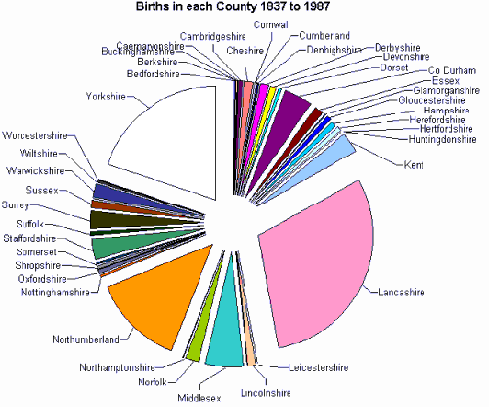
We have also been able to work on the data and can set out below a chart showing the English Counties of Birth 1837 to 1987. As mentioned in Issue 2 the predominant counties are Lancashire 30%, Yorkshire 20%, Northumberland 13% . These are all Northern counties. Taking all northern English Counties including Cheshire, these account for 70% of all clan births.
After the big three counties above, the next largest county return is for Middlesex with 5%. Middlesex takes in much of North, central and part of East London. The modern trend of births since the war is for an increasing percentage of births in the Southern counties. This reflects the economic and political changes in Britain which caused wealth to gravitate to the South east of England. This trend is one which appears to be accelerating since Britain joined the Common Market with the European Economic Union exerting its own demographic and market forces on Britain.
Administration
Also we have acquired our brand new PC and decided on a combination of genealogy software packages to handle the data. The principle software we shall be using for inputting the database is "The Master Genealogist for Windows 95" with Genmap for demonstrating the geographic spread of the name, and Gedmate to produce attractive graphic family trees.
ResearchWe have commenced extracting clan details from the indexes of death's from the Central Register of Births Death and Marriages for England and Wales. This tedious but essential process will take some time to complete but we shall update you on progress in due course.
Origins
The information gleaned during the half year on the origins of the name from this was not terribly significant and only increases the view that the clan has been near invisible to much of British administrative records. The notable finds include:-
In her book Irish and Scotch Irish Research Vol I Margaret Dickson Falley BS at Page 375 and 376 lists Thoms Irish Almanac and Official Directory for the year 1847 which refers to a M Mullarky, a Baptist minister at Cloghjordan in Tipperary. It may be coincidence, but it seems unlikely, that the Baptist minister for Parsons town in Kings County (Laois) is also called M Mullarky. One wonders on the difficult life of this man who may not only have converted to a Protestant religion, but even had become a minister. He would in all probability have been cut off from family and life long friends and hence his mobility between scattered distant Baptist parishes.
Prior to 1857 there were two classes of Wills, Prerogative and Diocesan. Before 1857 most Wills (Diocesan) in Ireland were proved in the Consistorial Courts, i.e. the Courts of the Church of Ireland bishop, within whose diocese the testator dwelt. But if the effects were valued at £5 and over, (bona notabilia) and located in two or more diocese, then the will was proved in the Prerogative Court of the Church of Ireland Archbishop of Armagh. This was also the supreme court in Ireland for matters ecclesiastical. Hence those wills proved in the Prerogative court were the most important, as they referred to the important members of the community. The Prerogative Court system commenced in 1536 and until 1816 cases used to be held in the private residence of the judge, though sometimes were held in the Chapter Room of St Patrick's Church of Ireland Cathedral. In the Index to the Prerogative Wills of Ireland 1536 - 1810 by Sir Arthur Vicars, he notes at page 341 two wills, firstly an Augustin Mullarky in 1808, though he provides no location and a Patrick Mullarky of Colga, county Sligo in 1805. The accumulation or preservation of wealth by these two native gentlemen would have been quite an achievement and testifies to human wit and survival instincts against all odds.
In the Index to Clonfert and Kilmacduagh Wills edited by Patrick A Smythe-Wood at page 13 there is listed a diocesan will for a Belinda Mullarky in 1810, 1811. The diocese in question covered an area mainly within Galway, Roscommon and a small part of Offaly.
The Surname Index to the Irish Patent Rolls of James I (1603 -1625) lists numerous individuals with names, which could be early versions of the name in English, or are phonetic attempts to transcribe the name. These entries are primarily the 1609 Pardon lists for those involved in the O'Dougherty rebellion of 1608. The pardon lists note pardons for approximately 1,490 persons, nearly all men, though not exclusively so, nearly all from Ulster, but with a sprinkling from other places (notably Wexford). The names are nearly all Gaelic, mainly Irish with some Scottish. There are a couple of Old English/Norman Irish names, but no New English names. The overwhelming impression of the O'Dougherty army is one which was primarily Gaelic, which either failed to gain support of the Catholic Old English, or which simply saw no value in such an alliance. The call to colours clearly did gain some external Gaelic support, but checking through the names the high percentage of O'Dougherty's amongst the Pardon Rolls, implies that the bulk of O'Dougherty's army was clan, or local to the O'Dougherty base in North West Donegal. This may give clues to the location of the Ó Maelearcaidh clan.
| Name | Page | Date | Patent Roll James I | Ref | Possible / Probable | |
|---|---|---|---|---|---|---|
| Donell O'Molauge | 138 | 10 Mar | 6 | CIV.-38 | Possible | |
| Nice O'Mologe | 136 | 9 Mar | 6 | CIII.-37 | Possible | |
| Derbie O'Mologe | 136 | 9 Mar | 6 | CIII.-37 | Possible | |
Donogh O'Mologe |
10 Mar | 6 | CIV.-38 | Possible | ||
| Tomline O'Mologe | 10 Mar | 6 | CIV.-38 | Possible | ||
| Owen O'Molouge | 138, | 10 Mar | 6 | CV. -40 | Possible | |
| Owen O'Moloug | 139 | 10 Mar | 6 | CV. -40 | Possible | |
| Brian O'Molouge | 139 | 10 Mar | 6 | CV.-40 | Possible | |
| Brian O'Mologie | 136, | 9 Mar | 6 | CIII.-37 | Possible | |
| Felonie O'Mologie | 137, | 9 Mar | 6 | CIII.-37 | Possible | |
| Dermot O'Mologhe | 136 | 9 Mar | 6 | CIII. -37 | Possible | |
| Maglaghy | 29 | 1 | Possible | |||
| Qui Connor O'Moloricke | 137 | 9 Mar | 6 | CIII.-37 | Probable | |
| Murtagh O'Molericke | 136 | 9 Mar | 6 | CIII.-37 | Probable | |
| William O'Molericke | 136 | 9 Mar | CIII.-37 | Probable | ||
| Moylemore O'Molericke | 136 | 9 Mar |
CIII.-37 | Probable | ||
| Owen O'Mullericke | 137 | 9 Mar | 6 | CIII.-37 | Probable | |
| Hugh O'Mulhericke | 137 | 9 Mar | 6 | CIII.-37 | Probable | |
| Turloe O'Mullarkie | 136, | 9 Mar | 6 | CIII.37 | Probable | |
| Manus O'Mullarkie | 138 | 10 Mar | 6 | CV. -40 | Probable |
The above lists 8 individuals with Mullarkey or Mullherick names. Additionally there are 11 persons with Mullogie type names. If all are English corruptions of the same name this gives us a total of some 20 individuals or 1.34% of those pardoned. Even if just the Mullarkey and Mullherrick names are counted this still represents quite a concentration of our clan. If as reported our clan left Ulster for Connacht at the end of the 16th century, it implies that when rebellion started, the Connacht exiles flocked to O'Dougherty's side. As an alternative explanation for clan involvement with the O'Dougherty's is that some clan may have moved further north into O'Dougherty territory, rather than west to Connacht.
One striking point about the above Pardon list is that nearly all names carried the prefix 'O'. This is something which rarely occurs with the anglicized versions of the name when written today. This together with the possible attempts at phonetic transcription demonstrate a degree of respect for the individuals concerned. It shows the degree to which the English language had not impacted on Gaelic. The list has to be understood in the context of the history of the time.
Tanistry
If we are ultimately unable to locate reference to our tanist history, then the question arises whether it would be appropriate to elect a new clan chief in a purely honorary role. This begs the question as to who would have a right to vote and how the election should be organized. It may be that tanist tradition varied clan to clan, however as with much of Brehon (Native Irish Law) it may well have been provided for in the Seangus Mór, a compilation of Brehon Law. This is an area which clearly requires further research. The Foundation has no intention of establishing a bogus clan chief, or clan structure. However, if research established the identity of the last clan chief, then from his descendents we might be able to create a derbfine, or class of candidates, from whom we might legitimately elect a new chief. With a legitimate clan structure, we might seek to join the Irish government sponsored Clans of Ireland.
The Clan also has an alternative approach to follow, namely, to consider seeking Courtesy Recognition from the College of Arms in Dublin for a clan chief. The Chief Herald of Ireland provides the recognition for the living heir of the last known inaugurated clan chief, based on the English system of Primo genitur, rather than election from the Derbfine. The existing organization of surviving clan chiefs, currently chaired by the Earl of Desmond, all claim their Gaelic titles through this method. Primo genitur does have the one advantage that tracing the title down through the eldest sons of each generation does provide certainty of method, but sadly the difficulty is likely to be of establishing who would be the eldest son of each generation. The existing clan chiefs are from famous Irish families and thus, their family histories are more easily traced through the general history of Ireland and Europe. For our clan probably establishing part of the Derbfine may be as much as we could realistically hope for. Hence following the Gaelic rather than the English system may prove more successful.
US Emigration Data
In the 18th and 19th centuries, an obvious place to find records of our clan would be from amongst the passenger lists of the many emigration ships to the new world. In his book Irish Passenger Lists 1847 - 1871 by Brian Mitchell, he lists passengers sailing from Derry to the USA on the J & J Cooke Line and the McCorkell Line. At page 233 he notes a Charles and Mary McLarkey sailing on the William McCorkell Ship the Minnehaha, which was engaged to sale in Philadelphia in March 1869 and which actually left Derry in April 1869. Their place of joining the ship is given as Moville P.O. It was common for emigrants to travel to the coast and then to contact the shipping line from a post office close to Derry. Moville P.O. sounds like such a post office address. Hence the departure address may not be the home address of the emigrant. One wonders from such snippets of information as to the identity of the persons. Were Charles and Mary married, were they brother and sister, were they travelling to Philadelphia to join family members?
The book also lists a Patrick McLarkey, who travelled on the Village Belle in May 1871 also from Moville P.O. Was he a relative of Charles and Mary? Its interesting that this rather rare version of McLarkey occurs several times. Additionally he notes a James McLarchy from Donamore, travelling on the John Clarke a ship of the JJ Cooke Line in 1847 to St John in Canada. This was around the time of the Irish famine, when tens of thousands were fleeing starvation and disease. One wonders did Patrick survive the journey, or was he one of the unknown poor who ended up in a mass grave near St Johns.
Then there is a Bridget Melarkey from Ballymagarahy near Moville, who sailed for Philadelphia on the Minehaha in August 1866 and John Mullarkey also from Ballymagarity near Moville P.O., who sailed on the Village Belle in April 1867. Despite the spelling differences, were Bridget and John connected?
The historical context in which the Ó Maelearcaidh clan developed in Ireland - Series Issue No. 3
We set out below part 3 of our short Irish history series. In order to place
the Ó Maelearcaidh clan data into it's historical and sociological
context we shall over several issues set out a history of Ireland, covering the
period from approximately 1140 to the early 1800's. Within the context of a
general history, we shall provide a more detailed account of events between
1500 and 1700, as this was the defining period during which the Gaelic order,
the clan system and culture underpinning it were transformed into the proto
system and culture of the modern day.
The Red Earl
Following the death of William de Burgo, conflict broke out throughout his territories, as rivals jostled to take pieces of the local Lordships. His son and heir, Richard de Burgo, was only 12 years of age. Nevertheless the situation forced him to grow up quickly. In 1280 he launched a fresh campaign to consolidate his father's domain. By 1296 he had expanded his lands deeper into Mid Ulster, earning for himself the nickname of the Red Earl. By 1300 he had managed to gain controlled the entire Inishowen peninsula and was the undisputed power over the eastern half of Ulster.
The Red Earl strengthened his power base by arranging various impressive marriage alliances. His son married a granddaughter of Edward I, and other children married powerful Norman Irish earls. Another of his daughters married the Earl of Gloucester in England. It would be fair to say that through these alliances he became the most powerful man in Ireland. Nevertheless his fiefdom was in a constant state of war with Irish clans, both from the west of Ulster raiding the overextended borders of his empire, and even from recalcitrant clans within east Ulster.
Despite his policy of encouraging English and Normans to settle in the Lordship, the native Irish were the majority even in the heart of his territory on the Down and Antrim coast . Further inland towards the borders of his earldom there were few Englishmen. Despite England's burgeoning population, these dangerous borderlands were unattractive to English settlors. Settlers were more interested in acquiring land in the more developed, richer and safer lands of Leinster and Munster.
The Red earl was ultimately forced to employ Irish clans to help defend his territory from external rampaging attacks. The result was that the Irish began to learn and acquire Norman military technology. Along the borders of the lordship native Irish princes even had the temerity to build Norman styled stone castles to the latest specification. Under the strong leadership of the Red Earl, Norman power had reached its zenith in Ulster. The inherent demographic weakness of the Lordship had been offset only by the Red Earl's military advantage and his dynamic character.
Interaction with the Scottish Gael
The natural cultural links with the Gaels of Scotland, led to an interaction between Scotland and Ireland. On occasions this resulted in military co-operation against the common English enemy. But as a counter force Normans based in Ireland also assisted the English king to campaign in Scotland. In 1296 the Red Earl joined Edward I in his vicious Scottish campaign. Along with many English Normans the Red Earl became increasingly interested in Scottish affairs. He even arranged for his sister Egidia to marry James the Steward of Scotland. In 1302 his daughter Elizabeth married no other than the Earl of Carrick, otherwise known as Robert the Bruce. The Bruce family were half Norman half Gaelic, with lands in Scotland and in England. Until he began to ravage their Scottish estates, the Bruce's were well disposed to Edward I of England.
As English demands increased, Robert Bruce pleaded the case of Scottish independence from England. Not surprisingly the English Crown ignored the claims. However matters came to a sudden head when the famous Scottish noble of Braveheart fame, was crowned king of Scotland in 1306. The new English king, Edward II, was not about to accept the situation and he sent armies against the Bruce. In Ireland the Red Earl, despite his sister's marriage to the Bruce, remained a loyal Norman and sent troops, including his native Irish troops to assist Edward. The Scots army was heavily defeated by the English and in the winter of 1306 the Bruce took refuge on the Irish island of Rathlin. There with help from the independent native Irish he regrouped his forces. Refreshed after the brief exile in Ireland, the Bruce returned to Scotland in 1307 and renewed the fight to regain his kingdom from the English. Whilst on Rathlin he wrote a letter addressed to the kings, prelates, clergy and inhabitants of Ireland "his friends" to help him with the struggle. On 9 February 1307 18 ships landed on the Scottish coast of Galloway with the Bruce's brothers Alexander and Thomas, together with Scottish and Irish allies. Sadly Dungal Mac Dubhgaill traitorously captured these forces, and beheaded both the Scottish lord of Kintyre and the leader of the Irish. The two Bruce's and other prisoners were sent to London for hanging, drawing and quartering. Despite the setback, at the battle of Bannockburn in 1314, the army of Robert Bruce decisively defeated the English, so securing Scottish independence and thereby ending the Anglo-Scottish war.
Robert Bruce had close connections with Ireland on the Gaelic side of his family. Indeed Edward Bruce, his brother, was probably fostered in Ireland with the family of Domhnal Ó Néill. It was not surprising therefore that in 1315 Edward Bruce was invited by Domhnal Ó Néill to help the Irish in their struggle against the English. The Scottish landing coincided with a disastrous harvest and a terrible famine. The population of not just Ulster, but of Ireland as a whole was weakened by the terrible famine. The timing for a rebellion was all wrong with the population more interested in survival, than in war and liberation.
Ireland was rent with strife. Gael and Normans competed for local hegemony, and Gael fought Gael for both provincial kingship and to hold the mantle of high king. Despite the Gaelic culture, unifying the Gael from the Blasket islands in the south of Ireland to the John O'Groats in the northern tip of Scotland, despite the popular and literary awareness of the Gael that Ireland and Scotland were nations, the Gael sadly had no political unity. Each clan saw clan expansion against all outsiders as the natural state of affairs. Sadly Edward Bruce was entering a struggle where his presence was not going to be met with universal support, the Irish were not a united people.
The Scots launched their campaign against the Red Earl's coastal castles overwhelming them one by one. Many of the Red Earl's most powerful barons such as Sir Thomas de Manderville were simply swept away by the onslaught. Buoyed up with success and their ranks swelled with Irish allies, such as the troops of Domhnaill Ó Néill, they destroyed the English stronghold of Dundalk. This was going to be the most vicious war in Ireland, with old scores settled by acts of atrocity. At Ardee a church filled with settlers claiming sanctuary was burned. Edward Bruce with Uí Néill help then advanced on Coleraine.
The security around the invasion plan had been so effective, that for once in history the English in Ireland were totally taken by surprise. The Red Earl was not even in Ulster when the Scots fleet landed. He had been on campaign in Connacht, ensuring that the de Burgo estates there were being properly defended from native incursion. He rapidly turned his troops east to meet the threat. Along the way he recruited the native king of Connacht, Felim Ó Conchobhair. The Red Earl's army cut a brutal swath across Ireland, murdering anyone in it's path. As the Red Earl's forces converged on the Scots, another even larger Norman army led by Edmund Butler, the king's Viceroy in Ireland was marching north from Munster. The Red Earl wanted to destroy the Scots by himself, fearing that the Viceroy might dispossess him of his Ulster earldom and bring it under direct rule from Dublin.
When the two Norman armies did not unite, Edward saw his opportunity to defeat them and he sent out secret messages to the Red Earl's Irish ally, Felim Ó Conchobhair. Edward Bruce offered Felim his kingdom, without external interference, if he would desert the Red Earl and support Edward Bruce's claims in Ireland. The offer was accepted and Felim's forces retired, at which point the Scots-Irish coalition launched their attack. The Red Earl was forced to retreat and on 10 September 1315 at Connor by the Kellswater not only was his army completely routed, but his cousin Sir William de Burgo was captured. By this stage only Carrickfergus Castle remained of the once mighty Lordship of Ulster.
The remnants of the Red Earl's army headed for the castle, where they prayed for deliverance by king Edward II of England. Edward Bruce's army received badly needed fresh troops in November 1315, when the Earl of Moray landed in Ireland with Scottish reinforcements. Edward Bruce left part of his army to besiege Carrickfergus and marched with the rest of his force against Norman troops of Roger de Mortimer and the de Lacys encamped at Kells in Meath. These were defeated, but then on 26 January 1316 he turned inland to meet the more substantial army of Lord Butler at Ardscull, near Athy. The Scots won a great victory, but the cost of prolonging their campaign into winter, through deepening famine was that the country was unable to support his men. The Scots were forced by hunger to march back to Ulster. There the Scots obtained some supplies from Scotland , but the famine was not local to just Ireland. It was part of an ecological disaster, affecting the whole of Europe, brought on by a sudden climate change, in which there was a noticeable cooling of temperatures. The Norman defenders in Carrickfergus were now in a terrible condition, as several attempts by Edward II to get supplies to them failed. Sir Thomas de Manderville led one attempt, which even got into the town of Carrickfergus early one morning, but the Scots detected the incursion and in the street fighting which followed, de Manderville was killed and the supplies captured by the grateful Scots. The defenders in the castle tried to break out to recapture the supplies but in vein. The Red Earl used yet another food shipment from Edward II, intended for the defenders, to bribe the Scots to free his cousin.
Books researched in the Society of Genealogists library, in London
| Book Title | Publishers | Publish Date | ||
|---|---|---|---|---|
| Lewis's Topographical Dictionary Of Ireland - Index of Names edited by Colonel F Wall C.M.G. | 1846 | |||
| Biographical Dictionary of Irishmen in France by Richard Hayes | M.H. Gill and Son Ltd.:Dublin | 1949 | ||
| A Dictionary of Irish Biography by Henry Boylan | Gill and MacMillan Ltd:Dublin | 1978 | ||
| Concise Dictionary of Irish Biography by John S Crone M.R.I.A | Kraus Reprint Nendeln:Liechtenstein | 1970 | ||
| Compendium of Irish Biography by Alfred Webb | M.H. Gill and Son Ltd.:Dublin | 1878 | ||
| Vol 1 Lives of Illustrious and Distinguished Irishmen from the earliest times to the present period edited by James Wills AMTCD, M.R.I.A. | MacGregor, Poulson and Company:Dublin | 1843 | ||
| Vol 1 Part 2 Lives of Illustrious and Distinguished Irishmen from the earliest times to the present period edited by James Wills AMTCD, M.R.I.A. | MacGregor, Poulson and Company:Dublin | 1843 | ||
| Vol 2 Part 1 Lives of Illustrious and Distinguished Irishmen from the earliest times to the present period edited by James Wills AMTCD, M.R.I.A. | MacGregor, Poulson and Company:Dublin | 1860 | ||
| Vol 2 Part 2 Lives of Illustrious and Distinguished Irishmen from the earliest times to the present period edited by James Wills AMTCD, M.R.I.A. | MacGregor, Poulson and Company:Dublin | 1860 | ||
| Vol 3 Part 1 Lives of Illustrious and Distinguished Irishmen from the earliest times to the present period edited by James Wills AMTCD, M.R.I.A. | MacGregor, Poulson and Company:Dublin | 1860 | ||
| Vol 4 Part 2 Lives of Illustrious and Distinguished Irishmen from the earliest times to the present period edited by James Wills AMTCD, M.R.I.A. | MacGregor, Poulson and Company:Dublin | 1862 | ||
| Irish Family History a catalogue of Autographed letters addressed to Sir William Betham Ulster King of Arms C 1810 - 1830 Betham letters by George Sherwood | March 1836 | |||
| The Irish Parliament 1775, edited by William Hunt MA DLitt. | Longmans, Green and Co. Hodges Figges & Co Ltd: Dublin | 1907 | ||
| How to trace Family History in Northern Ireland by Kathleen Neill AGRA(G) | Irish Genealogical Association:Belfast | 1986 | ||
| The Civil Survey AD 1654 -1656 Vol II CO Tipperary Western and Northern Baronies with the return of Grown and Church lands fro the whole County by Robert C Simington | Stationery Office : Dublin | 1934 | ||
| The Civil Survey 1654-1656 Vol III Cos. Donegal, Londonderry and Tyrone edited by Robert C Simington | Stationery Office: Dublin | 1937 | ||
| The Civil Survey 1654-1656 Vol IV Co. Limerick edited by Robert C Simington | Ditto | 1938 | ||
| The Civil Survey 1654-1656 Vol V Co. Meath edited by Robert C Simington | Ditto | 1940 | ||
| The Civil Survey 1654-1656 Vol VII Co. Dublin edited by Robert C Simington | Ditto | 1945 | ||
| The Civil Survey 1654-1656 Vol VIII Co. Kildare edited by Robert C Simington | Ditto | 1952 | ||
| The Civil Survey 1654-1656 Vol X Miscellanea (Louth part) edited by Robert C Simington | Ditto | 1960 | ||
| The Civil Survey 1654-1656 Vol IX Co Wexford edited by Robert C Simington | Ditto | 1953 | ||
| Ireland The Albert E Casey Collection and other Irish Materials in the Samford University Library. Compiled by Georgia V Fleming-Haigh | Samford University Library Research Series Paper No 3,Birmingham,Alabama | 1976 | ||
| Ecclesiastical Register Ireland 1830 Edited By John C Erck A.M.,LLB | R Milken & Son, N Mahon And R M Timms, Dublin | 1930 | ||
| Irish Church Directory and Year Book 1932 edited by Rev Canon J B Leslie MA, D.Lit, MRIA | Church of Ireland Printing and Publishing Co Ltd, Dublin | 1932 | ||
| Ireland The Albert E Casey Collection and other Irish Materials in the Samford University Library. Compiled by Georgia V Fleming-Haigh - a supplement | Samford University Library - supplement, Birmingham,Alabama | 1985 | ||
| Irish Schools for Irish Boys by Maurice C Hime MA, LL.D | Sullivan, Brothers, Dublin | 1887 |

Material Copyright © 1998 Fondúireacht Chlann Uí Mhaelearcaidh