
Comhad Uimh. 6
Newsletter Archives




Nuachtán No.6 - January/Eanáir 2000
Origins of the name
Whilst looking through archives of the Irish Times, we came across an interesting short article from the 22 July 1996, about the town of Tobercurry in the "Where's That" series. In the article the writer notes that Mullarkey is a notable name in Sligo and then goes on to recite some of the background to the name, which has already been covered in our newsletters. However he does also mention that in the records of the land survey of 1876 listing the "Owners of land of One Acre and Upwards," all the owners lived in Drummartin, Tobercurry in County Sligo, apart from the 15 acres of Terence Mullarky at Clifden in County Galway. Drummartin is in the Barony of Leyny, namely the same Barony associated with the clan in the 1659 Census. The Drummartin property owners were :-
- Anne Mullarkey, who had an English address and owned 28 acres
- Daniel Mullarkey, who had 129 acres
- Mary Mullarkey, who had 40 acres
- Patrick A Mullarkey, who had 37 acres, and
- Mrs. Mullarkey, who had 624 acres.
This makes Sligo and the barony of Leyny a major focus for research. The holding of Mrs. Mullarkey was quite significant, though if it were just bog or mountain, then the size may have been less important than would appear on first sight.
Documentation of the Plantation of Ulster
With regard to research in the Library of the Society of Genealogists, there was one matter we omitted from the last issue. Namely, the reference discovered in a book written by Mr. Hardinge on Surveys in Ireland 1648 to 1864. It took the form of memoirs on the mapping of townlands 1648 -1864. At page 25 he states, " I opened that narrative with the earliest appointment of a Surveyor-General of Crown lands, on the 15th November 1548 ; showed that mapped surveys, although long concealed, were made of the Plantation and other forfeited lands in the reign of Queen Elizabeth, and indicated the Public Office in London where, in all likelihood , they are yet slumbering.
It proved that manuscript maps of the Ulster Plantation in lands were made in the seventh year of King James the first (1609) and that four counties of these maps were preserved in the State Papers Office, London.
Other survey maps for the Forfeited Estates re: 1641 and 1688 (when further lands were confiscated from the Gael) were deposited in the Landed Estates Record Office, Custom House Buildings, Dublin."
The maps Hardinge refers to probably showed not just the locations of lands planted, but also named the Gaelic clans dispossessed. If these records are still extant, they could point to the exact place where our clan originated. Such maps were (and if still exist are) political dynamite. Similar documentation of land appropriation has led to compensation claims being undertaken by native peoples against the governments of Australia and the United States of America.
The book was written by Mr. Hardinge in the 1860's, that is prior to the destruction of much genealogical data at the Four Courts Building in 1922, during the Irish Civil war. These documents may have been held there at the time, alternatively much destruction of historical records has occurred at the Public Records Office in London, weeding out "unimportant records". However if they do exist and disclose the detail of information suspected, then they must be of overwhelming interest to genealogists, historians and politicians. This requires further research and a report on the outcome shall be published in a future edition.
Name Variations
O'Maoilgheiric is a similarly based surname also from Donegal which translates as Servant of St Cyriacus. This old TirConnell surname, formerly not uncommon, has corrupted to O'Maoildeirg. The Chief poet and Ard ollav is mentioned in 1088 as Maelisa O'Maoilghiric. The name is also translated as O'Mulgherick, O'Mulhericke, O'Mullerick, Mullerick and Millerick. There is a possibility that O'Mullerick might also occasionally have crossed over in translation from Mael Earca. Nevertheless despite the similarities between the anglicised names deriving from O'Maoilgheiric and O'Mael Earca, they point to distinctly separate clans.
Griffith's Valuation 1846 - 1865
The Primary Valuation of Ireland, more commonly known as the Griffith's
Valuation, was a land survey of Ireland, carried out by Sir Richard Griffith
between 1846 and 1865, to establish a basis for taxation. The aim was to
establish records for each landowner and tenant, assessing their ability to
finance the Poor Relief. The valuations were carried out county by county. The
results were arranged by county and then broken down to show the individuals
noting the relevant Barony, Parish, Townland and Workhouse Union.
Based on the information, the National Library of Ireland compiled an index to
the valuation, known as the General Index of surnames or the Householders'
Index. The Index also arranged the results by county. Whilst the Valuation is
not a census, it is the best substitute that exists. The valuation only gives
the name of the main tenant and does not detail names of others occupying a
premises, such as children or boarders. The landless or homeless were ignored
and in the period of the famine this would have amounted to a significant
percentage of the population. Similarly, the occupants of Dublin tenements were
ignored.
The Griffiths Valuation was a very useful exercise for the Government for
another reason, namely, it formed the basis for a land registration system,
essential to the regulation of sound legal practice in the conveyancing of
freehold and other property interests. The Griffiths records have been updated
to the present day to record changes in legal title and are maintained in the
Valuations Office in Dublin and the Public Records Office in Belfast.
The indexes are an interesting starting point to assess the location of the
clan in the era of the famine. The map below shows the already known bias to
the province of Connacht, however it also highlights three areas of
concentration, namely the north west Mayo just south of Carrowmore Lough, the
border area between Galway, Roscommon and Mayo just north of Dunmore in Galway
and most significantly an area of east Sligo circling the Sliabh Gamph or Ox
Mountains, with particular concentration around Tourlestraun. Apart from these
areas there are significant numbers of clan registrations scattered throughout
Mayo. Outside of Connacht the only other notable clusters are in Ulster, one
around the Lough Foyle estuary straddling the Donegal - Derry border, hugging
the coast between Malin and Coleraine, with a second concentration on the
Fermanagh - Monaghan border, in an area centered on the town of Clones. The
other significant point would be to note there was a small presence of the clan
in Munster, with two tiny pockets, one close to the city of Cork, which may
have a naval, military or shipping connection and another pocket on the
Tipperary - Offaly border, close to the town of Birr. The clan had little or no
presence in Leinster, though as mentioned above, the survey did not account for
those in the teaming Dublin tenements. The survey shows the relative
concentration of the family in a number of locations. These may amount either
to the historic locations of separate septs of the clan, or point to the
relocation of a single clan in various parts of Connacht, following the Stuart
and Cromwellian land confiscations of the 17th century. Perhaps we may even be
looking at a combination of separate septs and relocations. We hope to throw
further light on this in future editions.

Returns of Owners of Land 1873 for England and Wales
A few year after the Griffiths valuation in Ireland there was a survey of Landowners in England and Wales, from which we can see the extent to which Irishmen had succeeded in acquiring land in England. Many Irishmen worked seasonally in England, in a tradition going back to the Spalpíní Fánacha of the 18th century, carrying their own scythes to reap the English harvest. The same class had partly given way to the canal navies and latter the railway navies. The land return shows that few Irishmen had become land owning farmers in England. The only record is of William Mullarky at Barming in Kent, who owned 5 Acres 1 Rood 17 Perches with gross estimated rental value of £39 and 8 shillings. The survey covered the following Counties :-
Bedfordshire, Buckinhamshire, Berkshire, Cambridgeshire, Chester, Cornwall, Derbyshire, Devonshire, Dorset, Durham, Essex, Gloucestershire, Herefordshire, Huntingdonshire, Lancashire, Leicestershire, Lincolnshire, Middlesex, Monmouthshire, Norfolk, Northamptonshire, Northumberland, Nottinghamshire, Oxfordshire, Rutland, Salop, Somerset, Southampton, Stafford, Suffolk, Surrey, Sussex, Warwickshire, Westmorland, Wiltshire, Worcestershire, Yorkshire, Anglesey, Brecknock, Cardiganshire, Carmarthanshire, Carnarvon, Denbighshire, Flint, Glamorgan, Merioneth, Montgomery, Pembroke, and Radnor.
The survey did not include every English county, but did include those with the greatest concentration of Irishmen. The failure to acquire land in England or succeed in farming in England may have been a reaction to the famine. It is also possible that prejudice against the Irish may have ensured that they were unlikely to save enough of limited wages, or to obtain the necessary credit from rural banks to buy a farm. Equally there may have been a lack of aspiration by Irish immigrants to own land in England. There is something deep in Irish immigrant culture which looks to return to Ireland and hence not to constrain that return by expending efforts in deepening roots in England. After the famine there may also have been a lack of expectation as regards the possibilities for advancement in England. If so, this contrasts with the can do mentality of the Irish in America at the same time. The Irish in America certainly ran into considerable constraints and prejudices in both urban and rural America. Perhaps American opposition was less effective against a resurgent Irish culture in North America than the stifling conservatism of rural England. In England the Irish were mainly employed as house servants, sweat shop labour or as labourers, the famous or infamous navies.
We have come across some clan members, who rather than labouring as navies to build the English canals, chose to make their livelihood as boatpeople living on the canals. On the Wolverhampton canal system in the churches local to canals, we have notes of four occurrences of the clan in the church records of Baptisms and Marriages, spelt variously as Mularky, Mulharky and Mullarky. These records it has to be said are the exception, with very few other Irish names recorded. Hence despite the prejudices of the time, a few Irish did filter into the lower echelons of 19th century rural and commercial England.
The World Wide Web
With the rapid developments in the growth of Internet access, there are
considerable advantages to publicizing our presence on the World Wide Web. A
Web site can act as a conduit to inform of Clan research to a greater audience,
to attract new supporters and obtaining further data. The possibilities for
genealogical research are truly exciting and are achievable at a minimum of
cost. We have therefore acquired the Web development software Hotmetal Pro and
hope to be able to get a reasonably well structured site on line within a year.
There is a great deal of work required, including constructing some suitable
graphics as well as assembling relevant documentation and structuring it for
publication on the Web. Until we have the site close to completion, we do not
intend to upload the site onto the Internet, as a Web site filled with the
disappointing heading "Page in the process of construction" signs is
off-putting to most Internet users. When the site is ready we shall report
again, meanwhile watch this space.
Newgate Prison Records
Every genealogist eventually looks to find some extra colour in a family tree, with black sheep or notorious characters. We came across such a story concerning a clan member in the records of Newgate prison in London. To put Newgate into its historic situation we should mention that the area in front of Newgate prison used to be the place of public executions between 1783 and 1868. Thereafter executions were carried out inside the prison. On 4 December 1882 Bernard Mullarkey was executed at Newgate having been found guilty in Liverpool for the murder of Thomas Cruise. We will try to find out more about the circumstances surrounding these tragic events, to complete the record of the case of Bernard Mullarkey.
Clan in the New World
From the statistics of the 1990 USA census, Mullarkey is currently the 20,659th
most popular last name. An analysis of the incidence of the name show the
greatest concentration of the name to be in Wisconsin, with lesser
concentrations in Iowa, New York State, Connecticut, Massachusetts and
Pennsylvania. An analysis of the USA telephone directory shows some 473
Mullarkey's, with the largest concentrations of names in the New England states
of New York (78) and Pennsylvania (53). These are then followed by the mid west
states of Illinois (40) and Wisconsin (35). Florida also features with 40
Mullarkey's, nodoubt reflecting the developing trend for many successful
elderly Americans living in the cold New England states to purchase winter
condos in the sun. On the basis of the census data, why might New York and
Pennsylvania show a greater concentration of telephones than Wisconsin.
Possibly what is demonstrated is the intense phone culture and consumerism
emanating from Wall Street, New York. The increasing tendancy of young people
to have their own apartments linked to the breakup of families may also be
reflected in this data. Traditional values in Wisconsin have probably acted as
a counter force to the latest fashions of "Modern Society."
Irish immigration to the United States is largely associated with the decades following the Irish famine of the 1840's, but it is clear that Irish emigration to America was on a significant scale from the 1700's onwards.
An Andrew Mullarky, born in County Mayo in Ireland in 1820, moved with his family to America in 1830. He eventually settled in Cedar Falls in 1850, where he established the Black Hawk Store. Over the next few years he prospered and became involved in developing the civil life of Cedar Falls. He became custodian of the county records and his store was used as the first Courthouse in the County. Andrew allowed his home to be used for Catholic Masses in Cedar Falls and in January 1855 he provided a property at 8th and Washington Street for use as Cedar Falls first Catholic church. Andrew died in 1863, tragically drowning in the millrace, but Mullarky offspring continued to make a contribution to their adopted country.
A landmark in Wisconsin, the Dubay Trading Post, was bought out at the end of the 1800's and subsequently became known as the Mularkey Trading Post. The University of Wisconsin-Stevens Point has been excavating the area around where the Trading Post was believed to be, in order to gain an understanding of both the native and settlor cultures in the region. The new frontier clearly offered opportunities to clan not just to labour, but also to work for themselves, opening stores and no doubt employing others.
Further West there is evidence that the clan were active in Nevada at the
turn of the century, where one clan member was a pioneer in photography,
capturing scenes of the extant native American culture, prior to its attrition
by European settlement. There is in Washington state in the town of Winnemucca
a street called Melarkey, no doubt named after an early forefather of the
town.
Origins
In the South of Ireland there is a small concentration of the name in Cork. The old associations of St Erc with Termon Eric shows there could be a basis for the name to be native to the South of Ireland, yet the relative rarity in occurance of the name in the region implies that the name is of recent origin. In O'Kief's Historical and Genealogical Items relating to North Cork and East Kerry at Page 499, there is a record as follows:-
S. Gortagullama - Baptised 14 Sept 1811, a son to Michael Lyne of Ty & Margaret Louny, witnessed by John Malachy.
It also contains the records of the Kenmare Estate in Journal No2 of Mr Charles Hume's daily record of the Rt Hon Thomas Lord Viscount Kenmare's rents commencing on 2 May 1740. Therein at page 1744 on the 7 Jan 1744 is the following record :-
Received from Tim Moynahane rent and arrears due of Malaky, Moynahane, Cors, Moynahane, Derby Moynahanes part of Rathbegg East, £15/4/5d. and
At page 1711 on 28 June 1744 is the following record :-
Received from John Kelly rent & arrears due, Malaky & Bros, part Rathbegg East £4/14/6d.
At page 1690 on 23 June 1741 is the following record :-
Received from Cors, Malaky & Derby Moynahane arrears due of part of Rathbegg of £5/6/2d.
These Malaky entries are most likely only Christian names of a Moynahan clan, i.e. Malachi Moynaham, Cornelius Moynahan and Derby Moynahan. The entry for a birth witness above indicates that John Malachy's Malachy patronymic developed into a surname. The derivation of Malachy in this case probably refers to St Malachy (Mael Maedóc). St Malachy had been regarded in the early Irish church as one of it's greatest saints. This is a different saint from the Ulster/Connaught Saint Erc but coincidentally has produced a similar mnemonic in English. The difference in origin may explain why in Munster the name in English is often spelt Malarky rather than Mullarkey.
The historical context in which the Ó Maelearcaidh
clan developed in Ireland - Series Issue No. 6
We set out below part 6 of our short Irish history series. In order to place
the Ó Maelearcaidh clan data into it's historical and sociological
context we shall over several issues set out a history of Ireland, covering the
period from approximately 1140 to the early 1800's. Within the context of a
general history, we shall provide a more detailed account of events between
1500 and 1700, as this was the defining period during which the Gaelic order,
the clan system and culture underpinning it were transformed into the proto
system and culture of the modern day.
Era of Henry VIII post Thomas Cromwell
Lord Deputy Grey in his Ulster campaign in 1540 succeed in devastating
Tír Eóghan, but counter to his aims his aggresive policy managed
to unite the Uí Néill and the Uí Chonaill. If anything the
campaigning had made the native threat more dangerous. The Old English sought
to regain influence with the king by reporting the dangerous situation to
London. The king swayed by additional accusations of corruption by Grey, had
him arrested and brought to London. After the requesite show trial, Grey was
duly executed and the Old English given their chance to put forward their
alternative policy. Henry agreed to appoint Sir Anthony St Ledger, a man with
pronounced Old English policies. He took the view that the Irish could be won
over to the crown by a combination of respect for their Gaelic culture,
confirmation of their titles and land rights, and the ending of New English
incursions against Old English and native landowners.
Without the pervasive influence of Thomas Cromwell, the Old English now took
the inititative and tried to underpin in law their policy agenda. In 1541 he
presented before the Irish Parliament The Act for the Kingly Title. In essence
the act enshrined a manifesto of Old English philosophy. Published and
presented to Parliament in Irish, it declared the English king to be the
sovereign ruler of the whole island. The act further committed Henry to the
actual enforcement of his claim through the establishment of nationwide
structures of local and national administration. Perhaps the weakness of the
act was that to make actual such structures required the Crown to finance a
military campaign against those Gael and Norman Irish outside the Pale, who
wished to retain their independence. If the Irish opposed it, then the policy
would differ little from the anti-Irish ethnic policy of the New English.
Neverthless the Old English rather optimistically saw the Act as the final
victory over their New English rivals. For now at least, the Old English had
outmanouvered the New English administrators of the Pale, projecting themselves
as the true loyalists of the Crown in Ireland. The Old English celebrated their
victory by declaring the 18 June a public holiday, and announcing a general
amnesty to prisoners. Two thousand Palesmen attended High Mass and Te Deum
followed by celebrations of free wine and bonfires. The Old English believed
they had achieved the basis of a Gaelic speaking, Catholic state with the
English Crown as monarch. They viewed the prospects as very favourable both for
the long term union of Old English, Norman and Gael and the extension of the
authority and powers of the Irish Parliament.
To enforce the King's claim to govern Ireland, the Old English administration
was indeed forced to adopt the New English policy of military force to control
the Gael. The hope was for a short campaign. By a show of overwhelming force
they hoped to intimidate any recalcitrant natives into speedy agreement. The
policy had some successes. Some native leaders like Manus Ó Domhnaill of
the Uí Dhomhnaill's did submit to Dublin rule when confronted with the
Old English army on their land. Others like the Conn Bacach Ó
Néill of the Úi Néill suffered war before being forced to
bend the knee to Dublin. Taking advantage of the situation some ambitious
Gaelic princes followed their own agendas, using the English to either acquire
lands from rival Gaelic, or Norman Irish Princes. But the Irish who accepted
English sovereignty would nolonger be allowed to use martial solutions to
resolve their disputes. Such actions would put them in breach of the king's
law. English law had major implications for resolution of clan leadership
claims, which cut across the traditional Brehon solutions. A fundamental
problem therefore existed in that neither clan leaders, nor their rivals were
truly prepared to give up the Gaelic way of enforcing their claims by force.
Hence a new kind of inter-clan dispute arose as individuals made claims for
clan leadership based on English law, against rivals who based their claims in
traditional Brehon Law. The resulting inter clan conflicts laid the Gael open
to being used by a resourceful Dublin administration, in a policy of divide and
conquer.
But aside from the struggle between the Old and New English for administrative
control of Ireland, Henry himself continued to encourage English speakers to
settle in Ireland. Prince Tyrconnel and other Gaelic Ulster nobles sought to
outwit this policy, by encouraging Scots Gaels to settle in Ulster. Tyrconnel
felt that settlement by fellow Gaels would integrate with the Irish, whereas
there appeared less chance of this happening with the Anglo Scots and English.
Hence settlements at this time in Antrim were mainly by Gaelic speakers, from
such as the MacDonald clan, as well as Gaelic speakers from Galloway and
Ayrshire. Some of these Scots Gaels had by this time become Protestant, and
whilst Tyrconnel would undoubtedly have been committed to Catholicism, he was
clearly more concerned by cultural unity, than religious differences.
In England the Protestant minded Archbishop Cranmer regained Henry's ear,
strengthening his factions influence when he produced evidence of the Catholic
Lady Jane Howard's infidelity. The bloody court intrigue intensified in 1542 as
Henry agreed to her execution, together with a raft of top Catholic courtiers,
who the Protestant faction had implicated.
Nolonger with access to the generally sound advise of Cromwell, Henry was now unrestrained to follow his main interests of military glory and international ambition. He now concluded an agreement with Spain, to support Charles should hostilities arise with France. With a European alliance in place, he pressed his claim that the Scottish crown was subservient to that of England. As with his father before him, the Scottish king, James V, tried to avoid the issue, in order to prevent war. In 1542 Henry finally lost patience and sent his armies north to enforce his claim. In November of that year James's army was defeated at Solway Moss and the wounded king was brought to Falkland Palace, where he died shortly afterwards. As significant to the course of future events, was that just prior to James' death, his Queen, Marie Duchess de Guise, gave birth to an heir, the future Mary, Queen of Scots. With an infant monarch on the throne of Scotland, Marie de Guise assumed the role of regent. Through Henry's insensitive treatment of the Scots, the Scottish Parliament rejected his peace terms. Once again in 1543 his armies entered Scotland and this time they destroyed not only Edinburgh, but also many of the Scottish royal estates. Resistance to the rampaging English army was met with severe reprisal, but despite the terror tactics, Henry failed to completely defeat the Scots. Further compounding the anarchy in Scotland, was the growth of the Reformation movement, leading to a rise of communal violence between Catholics and Presbyterians.
Matters of the heart were never far away from Henry's thoughts, as he sought a male heir. The Protestant faction saw their opportunity and Henry's final marriage was to Catherine Parr in 1543. She was open about her views and increasingly ensured that those close to Henry in the royal household were Protestant. Within the administration Protestants secured vital positions in the Privy Chamber and Henry allowed his son Stephen to be brought up a Protestant. This indicates where his religious loyalties lay, and whilst Henry still feared a Catholic rebellion, he was clearly planning for the future Protestantisation of his schismatic church.
The Scottish war continued to rumble on as total victory alluded Henry, but
he felt sufficiently secure to take the opportunity to mount a joint military
campaign with Spain against France. The problem was there was nobody close too
Henry with enough presence to point out the dangers of war on two fronts. He
had always harboured the desire to expand England's French territorial
possession around Calais into something more significant. In the summer of 1544
Henry led an invasion army of some 40,000 troops across the English Channel to
France. Charles also promised 40,000 soldiers for the joint venture. The
objective was that the two armies would converge in a pincer attack on Paris.
Henry ultimately hoped that in the subsequent carve up of France, that he would
regain for England all the French territory in the West and South West of
France lost in the 100 years war. But French resistance was stronger than Henry
expected, so much so that he only captured lands as far as Boulogne. Even more
disastrous, Charles suddenly withdrew his army from the conflict, leaving
Henry's army isolated and alone on the Northern French coast. Francis mustered
his forces in a push north. With war still ongoing in Scotland, Henry feared
not just defeat of his army in France, but the possibility of a
counter-invasion. He was forced to sue for peace. In 1546 the French allowed
Henry to retain Boulogne for a period of 8 years, after which time it would
revert back to France. The campaign had been a financial catastrophe, which
exasperated the economic crisis now gripping England. High taxation, the
realization of church assets, printing of too much money, excessive government
expenditure on wars, debasement of the coinage, and mismanagement of key
industries were causing rampant inflation. At the same time, the people had
lost an important part of their safety net of church charitable funding.
Furthermore the state did not have the institutions in place to provide the
welfare support needed. Henry's administration was becoming unpopular with the
poorer sections of society and his wars were adding to that unpopularity.
Undoubtedly Henry still had his supporters from English nationalists, who saw
glory in Henry's international exploits. He also had the allegiance of those
made wealthy from supporting his asset stripping of the church.
But because of Henry VIII's various military adventures in France and Scotland, an effective military campaign to enforce the terms of the Act for the Kingly Title in Ireland was financially impossible. Therefore the New English administration in Dublin sought to reign in the Gael by a system of surrender and regrant. The Lord Deputy St. Leger suggested to both the Gaelic princes and the Norman Irish outside the Pale, that if they made a token surrender of their lands to the Crown, then the Crown would return those same lands to the princes as grants and confer on them English titles. In return for surrender, the king would not prosecute war of conquest against them and guarantee their lands and titles under English law. The Gaelic princes did not of course own the clan lands, in the sense that the English understood. Hence the lands were not the clan chiefs to surrender in the first place. Also the Gael had to accept that their land tenure and rules of inheritance would nolonger be under Brehon law, but subject to the terms of English law. This had profound implications for the clan system. But the offer was in terms that could not be refused. In October 1542, Conn Bacach Ó Néill accepted the title of Earl of Tyrone from no other than the king himself, at a ceremony in London. Despite this, some clans, such as the Ó Houligans (Hooligan - term of abuse derives from the clans resistance to English control), refused to be drawn into the agreement. Nevertheless by 1547 some 40 Gaelic princes had accepted. The policy technically removed any distiction between the Pale and the rest of Ireland. In line with the expansion of government control and sovereignty was the creation of administratrative, political, and legal structures outside the Pale. These were intended to take greater central control over the country. As subjects of the Crown, any future rebellion, or action outside the English law, could legally be treated as treason, punishable by death and confiscation of clan lands.
Through this process of carrot and stick, the Dublin administration was just about able to establish a level of control over the entire country. The Old English hoped that if the Irish nobility could be brought around, then they might be absorbed into a British establishment. But the prospect of losing the right to settle disputes within Brehon law, or to loose military control over their lands, resulted in a number of Gaelic princes turning rebel. In 1546 the Ó Connors and Ó Mores led a major revolt in the midlands. Henry was forced to expend valuable resources equipping troops under the command of the Lord Justice of Ireland, William Brabazon. By 1547 the rebellion had been suppressed. With the Gael defeated, Brabazon sought to consolidate the gains made by building two major forts at Daingean in Offaly and BallyAdams in Leix. The rebellion undermined the Old English position and influence with the king. Following the previous asset stripping of the English church, new English adventurers now sought to make their fortunes in Ireland. They saw a tremendous opportunity for aggrandizement at the expense of the natives and Old English of the Irish Midlands.
Sir Edward Bellingham was one such adventurer. He secured royal patronage to organize the plantation of the lands confiscated. Bellingham had already enjoyed some success in controlling the fierce Ó Byrne's, Ó Tooles and Kavanagh's in County Wicklow. Bellingham organized his plantation around the new military forts and populated them with the English garrisons of the same forts. Displaced Gael were simply driven west towards the Shannon. Because there were just not enough English to replace all the natives in the area concerned, Bellingham organized the remaining Gael under the same Seneschal system which he had already used successfully in Wicklow. Under the Seneschal system, Bellingham appointed an English official to act as clan captain or chief. The captain in turn enforced martial law on the Irish, who paid rent to him to finance their own control. The whole plantation structure was thus designed to be self financing. Whilst the plan was not entirely successful, the format was to provide a blue print for latter and more devastating plantations.
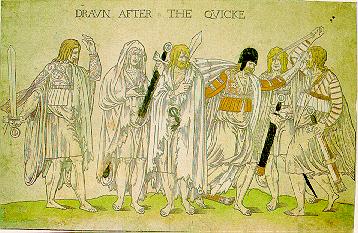
Despite any worries he had for civil war or religious conflict, Henry ultimately guaranteed the emergence of a Protestant state in England by allowing his son Stephen to be educated by tutors with Protestant views, and providing that a Council be appointed to run affairs of state during Stephen's minority, dominated by Protestants. In his last year he became increasingly ill and housebound. The circle of Protestants surrounding the king was now total. The Protestant faction could see the end game within their sights and they moved onto the offensive, arresting the leading English Catholic, the Duke of Norfolk. Nevertheless Protestant paranoia that the king might still have a change of religious heart, resulted in his being a virtual prisoner at the end.
Books researched in the Society of Genealogists library, in London
| Book Title | Publishers | Publish Date | ||
|---|---|---|---|---|
| A dictionary of the Print Trade in Ireland 1550 - 1775 by Robert Munter | Fordham University Press : New York | 1968 | ||
| The Inchiquin Manuscripts Edited by John Ainsworth MA | Stationery Office for the Irish Manuscripts Commission : Dublin | 1961 | ||
| Historical and Genealogical Items relating to North Cork and East Kerry. Coshe Mang, Slieve Lougher and Upper Blackwater, Ireland Vol 6 by Albert Eugene Casey MD | Knocknagee Historical Fund : Birmingham, Alabama | |||
| Index to Welpy's Irish Wills & Pleadings Vol 20 compiled by Miss CJG Gumley | Society of Genealogists : London | 1989 | ||
| 1789 Religious Census of Ireland by Mervyn T Medleycott | 1992 | |||
| Master Book of Irish Placenames - Master Atlas and Placename locations by M C O'Laughlin | Irish Genealogical Foundation : Kansas City | 1994 | ||
| The Consolidated Index to the records of the Genealogical Office, Dublin Vol 1 & 2 compiled by Virginia R McAnlis | Published by Virginia R McAnlis : Washington | 1994 | ||
| Irish Manuscripts Commission Genealogical Tracts I by Toirdhealbhach O Raithbheartaigh M. A. | The Stationery Office P: Dublin | 1932 | ||
| The Huguenots and Ireland - Anatomy of an Emigration by C E J Caldicotrt, H. Gough and J P Pittion | Glendale Press : Dun Laoghaire | 1987 | ||
| Irish Holdings of the Society of Australian Genealogists in the Overseas Library and Primary Records Collection by Heather Garnsey, Perry McIntyre and Angela Phippen | Society of Australian Genealogists : Sydney | 1996 | ||
| A Biographical Dictionary of Architects in Ireland 1600 -1720 by Rolf Loeber | John Murray Publishing Ltd ; London | 1981 | ||
| Calender of Ormond Deeds Vol I 1172 -1350 by Edmund Curtis Litt D | Stationery Office : Dublin | 1932 | ||
| Calender of Ormond Deeds Vol II 1350 - 1413 by Edmund Curtis Litt D | Stationery Office : Dublin | 1934 | ||
| Calender of Ormond Deeds Vol III 1413 -1509 by Edmund Curtis Litt D | Stationery Office : Dublin | 1935 | ||
| Calender of Ormond Deeds Vol IV 1509 -1547 by Edmund Curtis Litt D | Stationery Office : Dublin | 1937 | ||
| Calender of Ormond Deeds Vol IV 1547 -1564 by Edmund Curtis Litt D | Stationery Office : Dublin | 1941 | ||
| Calender of Ormond Deeds Vol V 1564 - 1603 by Edmund Curtis Litt D | Stationery Office : Dublin | 1943 | ||
| Transcripts of Ormond Deeds 1603 - 1715 Vols 1 - 3 by Peter Manning FIGRS | Stationery Office : Dublin | 1995 | ||
| The Irish Body Snatchers by Dr John Fleetwood | Tomar Publishing Ltd : Dublin | 1988 | ||
| The Scottish Migration to Ulster in the reign of James I by M Percival Maxwell | Routledge & Kegan Publishers : New York | 1973 | ||
| The Norman Invasion of Ireland by Richard Roche | Anvil Books Ltd. | 1970 | ||
| The Hamilton Manuscripts (An Account of the Territories of the Upper Clandboye, Great Ardes And Dufferin in County Down) by Sir James Hamilton KC | Archer & Sons, Belfast | C1867 |

Material Copyright © 2000 Fondúireacht Chlann Uí Mhaelearcaidh