
Dúchas na Clainne
Coat of Arms and other Clan Symbols










Clan Symbols
Clans can have a number of defining symbols apart from the clan name, these might include, a clan Coat of Arms, a Clan motto, a Clan warcry, a Clan tartan, Clan lands, a Clan castle, as well as dedicated Clan songs and poems.
Some Irish Clans never had any of the above and of those clans which did, only
the more famous can identify all of the above symbols. In this section we shall
attempt to discover to what extent, if at all, we can verify Ó
Maelearcaidh clan symbols.
- Coat
of Arms
The Clan Coat of Arms as shown on the top left of each page of this Web site is as reported by Macauley Mann Limited in 1989, which claimed the arms were described in The New Dictionary of American Family Names at Page 334. The official heraldic description of the Arms is Argent, a Fess Vaire, Or and Gules. In layman's terms the description translates as a silver or white background, with a bar across the shield containing a pattern known as a vair (representing an animal fur) coloured gold or yellow and red.
Unfortunately the above-mentioned book is out of print, though an American correspondent with access to a copy has informed us that no such arms are infact depicted in the publication. Rather interestingly we have seen the arms as depicted above on the internet site of yet another of the Genealogy memorabilia companies. As we have yet to discover an authoritative source for the arms given, we must leave this matter open pending our on going research. Once we can establish the validity of the arms we shall include such material on our Web site.
The question of heraldry in Gaelic society is a fairly complex matter and is discussed in great depth at http://homepage.eircom.net/~donnaweb/info/index.html. A brief summary of matters would be as follows:-
Clans in early Irish society had certain regional emblems often alluding to Celtic pre Christian beliefs or symbols, which they used in their war flags. To some extent a few clans may have had a clan coat of arms, which all clan members would have collectively identified, but there was not the elaborate system of conventions as developed in late Norman society.
With the arrival of the Normans in the 13th century they introduced into Irish society the concept of formal coats of arms. Norman arms were inherited by primer genitur through the eldest son, though often distinguished to separately identify father from son. The same system applied in England, but over time the ambivalent attitude of the Gael to rules began to affect the Norman Irish use of heraldry. Adoption of arms became irregular, so that adoption of arms was more by will rather than by inherited right. The spread in use of arms amongst the Norman Irish impacted on the Gaelic aristocracy, who begin copying the trend in use of arms.
These Gaelic aristocrats usually assumed arms incorporating the old clan motifs reflected in the war flags. Unlike the Norman Irish the Gael did not even pretend to follow the heraldry rules based on primer genitur, so that the clan arms were probably seen as the collective property of the entire clan. Matters changed dramatically with the arrival of the New English in Ireland in the early 16th century.
The New English brought with them strict rules on the rights of use of arms, strictly applied through primer genitur. To police the use of arms, a structure was introduced by Henry VIII's Irish deputy in 1552. This structure consisted of a College of Arms and a Herald known as the Ulster King of Arms. The aim was to patrol the loyalty of the Irish nobility whether they be New English, Old English or native Irish. As with land tenure, those Gaelic princes willing to accept the rule of English law, promote English culture and support the Crown were rewarded if they formally surrendered their old Gaelic titles and claims for new titles recognised by the English through the College of Arms. Through this system of "Surrender and Regrant" the Gaelic nobles hoped to retain their privileged status, albeit secondary to the New English. The stumbling block for many of the Gaelic nobles, frustrating the attempt to integrate them into a British aristocracy was their inability to wholeheartedly adopt the new English way of primur genitur, with it's individual culture, which cut across the traditional ways and Gaelic group/clan culture.
The task we now face is to establish who if anyone held the arms shown above and who if anyone granted their use. From the evidence we have thus far, the clan arms were not issued by the Ulster king of Arms. This means that either the arms are Gaelic in origin, arms granted by some third country such as Spain or France, or are bogus. We shall add to this section as we discover further information.
- Clan
Tartans and the kilt
When one thinks of the Irish and the Scots one conjures up many strong images associated with their distinctive identities. Despite the proximity in culture between the Scots and the Irish, one is more likely today to associate the kilt with the Scots. Nevertheless there is a general worldwide impression that the kilt is also an Irish symbol and would be described as the traditional native dress. In modern Ireland the kilt is much further removed from the public consciousness than in Scotland, where it is experiencing a renewed popularity. This coolness by the Irish towards the kilt should warn us that perceived views on the "traditional" nature of the kilt may not be correct.
Historically the kilt in Scotland has gone through several different and not necessarily connected versions prior to the development of the modern "traditional" kilt. Certainly a kilt of some kind existed from the late 16th century. Not until Sir Walter Scott’s romantic writings about the people of the Highlands affected a wave of “sentimental Jacobitism.” did the kilt become established throughout the whole of Scotland. King George the Fourth of England's royal visit to Scotland in 1822 is generally accepted as the birth of Highland costume as the Scottish National Dress.By contrast the imposition of English dress in Ireland effectively killed off the main aspects of Irish traditional dress in the 17th century, only for it to re-emerge as the kilt several centuries latter.
The question is what constitutes traditional dress? Over how many centuries must a dress persist ? For instance the modern kilt or filleadh beag in Scotland only dates from the late 17th century, when it was only really the dress of the highlands. The kilt only began to be accepted in the lowlands in the late 19th century, and was only accepted as the national costume in the 1820's. Is it sufficient that a particular dress is the pinnacle of native development prior to the conquest of a nation? What about the emergence of new national consciousness and new self created style during colonial occupation? Can a new self created style redefine national dress? These are important questions to get to grips with. The last native Irish dress ceased to be worn as long ago as the mid 17th century, following the military defeat of the last independent Irish nobles. Since then there has followed some three and a half centuries of Hiberno-British culture, during which time Irish dress has been broadly similar to that of England.
During the Celtic revival of the 19th century Irish scholars sought to redefine the separate Irish national identity, including the national dress, based on Ireland's Gaelic past. Indeed the same Gaelicism which affected Lowland Scotland is the same general movement leading to the adoption of the kilt in Ireland. With the information they then had to hand about traditional Irish dress of the 16th century, Irish cultural enthusiasts believed the kilt to be the pinnacle of independent Irish dress development. They therefore adopted the kilt not just as an expression of their Irishness but the common Gaelic culture. The wearing of the modern "Scottish" kilt in Ireland emerged as a cultural anecdote and not as a mass populist trend. In Ireland it has never broken free of this somewhat artificial folksy image. By contrast the kilt in its various forms was never fully removed from Scottish society, despite the banning of its wearing at several points of time.
If we are happy to follow those 19th century Irish cultural enthusiasts, then there is no reason why we cannot safely adopt their saffron kilt. However we can also say that in hindsight their research was flawed and that whilst the 16th century Irish and the Scots Highlanders did wear a common dress that it was not the kilt.
The scholar who proposed the theory that the Irish of the 16th century wore the kilt was the then Professor of Irish History at the Catholic University of Ireland, Professor Eugene O'Curry. In 1860 he published his findings in a scholarly work on the subject called "Manners and Customs of the Ancient Irish. Subsequent Celtic scholars and revivalists endorsed the work, notably the antiquarian P. W. Joyce. Based on this body of work, when Southern Ireland gained Home rule in 1921, the saffron kilt was adopted as Ireland's traditional dress. The view commonly expressed was that the kilt originally derived as a Celtic imitation of the Roman toga. But if that were true then one would also have to say that the Celts gave the toga a surreal make-over of their own.
Modern research points to the Celts themselves as the originators of the kilt. The oldest form of the kilt was known as the Filleadh Mór or Féilleadh Mór. The earliest reference we have to one is Irish and is dated 1594. Because of the nature of that first reference and the relatively plentiful descriptions of Irish and Scottish dress prior to the 1590's, it is fairly likely that the Filleadh Mór was a development of the latter part of the 16th century. This early references to the kilt point only to it being worn by the Scots of the Highlands, Isles and Scots gallóglaigh troops fighting with the Irish. Infact there is no evidence that the Filleadh Mór was worn either by Lowland Scots or the Irish in the 16th century. The idea "a la Braveheart" that the kilt was worn by the likes of William Wallace or Robert the Bruce in the 14th century is simply false. With a likely date of origin in the late 16th century even as regards Scotland, the Fealladh Mór kilt in hindsight is not so long established as previously supposed.
The Gaelic word for the kilt, filleadh mór derives from filleadh the Gaelic for a fold, or tuck and mór meaning big or great. The description is nothing if not apt. The Filleadh Mór consisted of a single piece of cloth, some 20 yards long, which was wound around the body of the wearer in a series of turns and tucks and held in at the waist by a belt. It must have been a major exercise to put on the robe and probably required the wearer to commence the process by placing the belt on the ground and lying a length of the pleated cloth over the belt. Then lying on top, more of the unpleated cloth would be folded across the wearer's waist. The next stage would be to fasten the belt to hold all the cloth together. Then standing up the wearer would wind the remaining length over his shoulders. Finally to complete the kilt, the wearer would pin the wound upper length to the lower part with a fancy clip. It must have been quite a chore to get the Filleadh Mór just right. The writer concedes he has enough problem getting the correct length with a tie, the prospect of dealing with 20 yards of material is just unimaginable.
As mentioned above the first clear description we have of the Fealladh Mór version of the kilt is in 1594. The Irish annalists who were with Aoidh Ó Domhnaill, the Independent Irish Earl of Tír Conaill made specific remark of the different dress of the Highland gallólaigh troops, recruited by Ó Domhnaill, to help the Irish fight the English and their allies in Ulster and Connacht. The reason for their specific remarks was because prior to that time the dress of Highlanders and Irishmen had been more or less identical. This previous similarity in dress reflected their common culture. Indeed the true division across the British Isles at the time had little to do with territorial borders, or religious differences, but the Gaelic - English cultural division following a line north of the Scottish lowlands and incorporating the Western Isles and the whole of Ireland, excepting Dublin.
The Filleadh Mór was originally fairly plain cloth, though the use of colourful tartan did soon emerge.
If the kilt was never worn by the Irish, indeed if the Highlanders did not wear the kilt prior to the 1590's, then we might ask what was the traditional Irish dress. There are several references to early Irish dress and these are remarkably consistent. They do indeed confirm that Highlanders and the Irish wore fundamentally the same dress and that it was not the kilt. King Louis XII's ambassador in Scotland between 1513 and 1515 reported to Louis that the Scots like the Irish, wear a large saffron coloured shirt, with a great garment (The Brat - see below) hanging down to the knees also coloured saffron, wrapped around the waist and tied with a belt.
Through An Comhairle Ealaíon (The Irish Arts Council), the Irish government sponsored research by H F McClintock into Old Irish dress during the 1940's. From his work published as "Old Irish Dress" in 1950 McClintock concluded that the 16th century Irish/Highland traditional dress consisted of 4 garments. These no doubt had variations as to regional embellishments and local differences in cut and dimensions. Despite these localised differences he concluded that one could classify the overall style of dress as Gaelic. The principal garment was the Léine Croich. This was a long smock type shirt, made of strong heavy linen, coloured bright yellow with saffron, an extremely expensive spice. The Léine Croich varied in length to just above the knee to almost down to the ankle. Length to an extent was dependent on the wealth of the wearer. The Léine Croich was also embellished with stitchwork, often of high quality using coloured silk thread. It also had long billowing sleeves and the body was usually pleated and gathered in at the waste with a belt. In consequence the garment consumed a huge quantity of material and in cash terms obliged the Gael to spend a disproportionate amount of their disposable income on clothing. The secretary to the Lord Deputy in Ireland in 1600 reported:-
"Ireland yields much flax, which the inhabitants work into yarne and export the same in great quantity. And of old they had such plenty of linnen cloth as the wild Irish used to weare 30 or 40 elles in a shirt al gathered and wrinkled and washed in saffron."
It has been stated that one of the reasons wearing the Léine Croich was banned by Henry VIII in 1537 was not just because it was different to English clothing, but that the extravagant use of material, especially the dying with saffron implied worldly status. This was something which Henry VIII would only countenance for nobles, and most definitely not for ordinary Irish peasants. Wearing the Léine Croich must have had its attractions, as despite ordinances against its use in Ireland by various invaders, they were all in time won over to wearing it. Just how long established was the Léine Croich is shown by a reference in Magnus Berfaet's Icelandic saga written in 1093. There Berfaet gives a clear description of the Léine Croich worn by Highlanders. Despite Henry VIII's proscription against it's use, by the mid 16th century the above described dress was adopted not just by most of the Irish, but also the Old English outside the Pale. Only in the heart of Pale around Dublin could one say the Old English in Ireland managed to consistently preserve their own dress. The New English however came to Ireland determined to maintain their Englishness armed with a new philosophy of colonialism. Their ethos was one of cultural superiority, which they used as leverage against the vested interests of the Old English Gaelicised establishment.
As a result of the warfare between the English and Aoidh Ó Néill's Ulster confederacy during the 1590's, the English tried to isolate Ulster from assistance from Scotland by basing their navy in the waters between Ireland and Scotland. A bi-product of the blockade was to weaken the cultural and economic links between Ireland and the Scottish Highlands and Isles. After 1601 the ravages of warfare disrupted the production of linen in Ulster. Furthermore following defeat of the Gael at Kinsale, the New English were able to more effectively enforce the anti-Irish provisions such as the ban on the Léine Croich. In response to these difficulties the Irish slowly began to accept English dress. The combined effect of these events also obliged Scots to seek an alternative to the Irish manufactured Léine Croich, to meet their clothing needs. In consequence they rapidly dispensed with the Léine Croich and in it's place adapted the Brat (See below) into the Filleadh Mór kilt.
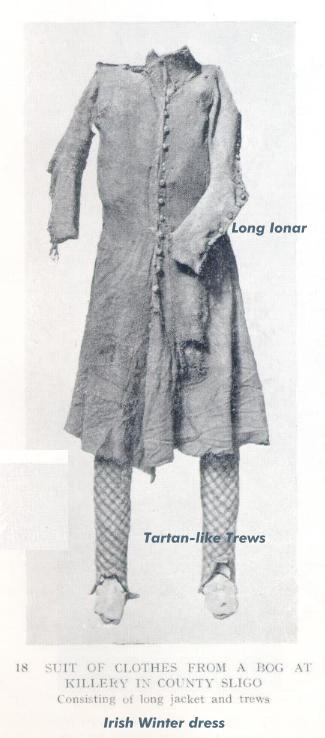
The second element of the traditional Irish dress was the Ionar, a short midriff-length woolen jacket, which was finished with an 8 - 10 inch long fringe of coloured strips of braid. The sleeves of the Ionar were cut back to to allow the Léine Croich sleeves to hang down. The Ionar seems to have been either Crimson, or Green and sometimes was heavily embroidered with Celtic patterns. One notable design element was that the Ionar usually had a few small slashes on the shoulders to typify sword cuts earned in battle. As mentioned elsewhere a man's reputation was the real measure of his worth in Irish society. Hence the martial touch to Irish fashion. Paintings by Lucas de Heere, a Dutchman exiled in England between 1567 and 1576 give fairly accurate portrayals of the native Irish. De Heere himself probably did not visit Ireland and though there may have been Irish exiles in England, these paintings were most likely copies of other paintings. Nevertheless they show the Ionar, coloured crimson of the same shade as the traditionally handwoven dresses worn down to the early 20th century by women in Conemara.
The third element was the Trews. These varied in size regionally. In Leinster they appear to be non existent, or very short like football shorts. As regards the style of clothing in the North of Ireland, we have the reports of John Derricke published in 1581. Derricke accompanied Sir Henry Sidney, the Lord Deputy in his Ulster campaigns. His book is an anti-Irish vitriol, however he did give us some useful descriptive comment on the native dress in North West Ulster. He also made detailed drawings of natives in MacSweeney's country of Tír Conaill. In view of our clan's possible origin in Tír Conaill these descriptions are especially apt. The drawing show the natives as nearly all wearing long ankle length Trews. The material from remnant surviving examples in Irish museums show that they were made of a lighter cloth than the Ionar. In summer when they needed to exert themselves, or travel the evidence is that the Irish tended to omit the Trews and went bare legged. These Trews were fairly tight fitting, full length trousers, held up with a cord sown into a wide seam at top of the Trews like pyjamas. They were held tight on the leg by a piece of cloth passing under the soles of the feet. The Trews might be white, plain coloured, red or even chequered brown and white, tartan-like. Derricke's paintings rather interestingly show the pleated Léine Croich as being worn shorter than in Leinster, giving a deceptively close similarity to the modern knee-length kilt.
The fourth element of dress was the Brat, a large woolen sleeveless cloak. The Brat was approximately semi-circular in shape, like a cyclist's waterproof, which was long enough to wrap around the body of the wearer and cover their head if necessary. When not in use the Brat was gathered in and worn over the shoulder, or across the body under the sword arm in battle. The brat was used as a distinction of rank. Coloured crimson it signified kingly status. However the brat was often variegrated or multi-coloured, in an early version of tartan. As explained above in the 1590's the Scots developed the Brat into the filleadh mór, or belted kilt. In Ireland the traditional Brat persisted, though an alternative more luxurious version developed. This improved Irish Brat was largely afforded by the wealthier Irish and differed from the normal Brat in that it was shaped to fit the shoulders and threads of the cloth on the inside of the Brat were drawn out, to give the illusion of fur. Similarly around the collar on the outside of the Brat the threads were drawn out and curled, to give a shaggy fringe. The improvements sought to make the Brat a warmer winter garment. There is some evidence that climatic changes may have inspired this developement. Indeed replacement of the Léine Croich for the kilt in Scotland may have also been partly as a response to a colder climate. The Irish "rug coat," as it became known was popular and was even exported to England and the continent. It was the only element of Irish dress which survived the repression of all things Irish during the 17th century.
Hence one could say that there was a loose connection between the kilt and Ireland through its common ancestor, the Brat.
Irish history and her climate have militated against the survival of clothing material. Irish archeologists have made a number of discoveries of bodies preserved in Ireland's bogs. The clothing so discovered is now displayed in the Irish National Museum. One find was a 16th century body in a bog at Killery in county Sligo. The acidic content of the bog completely destroyed the linen Léine Croich, however the woolen Ionar and Trews did survive, though the colours of the surviving garments were totally altered by the peat. The interesting factor was that the Ionar was cut long, down to the knee probably for the cold of winter. There are by contrast examples in the museum of the waste length Ionar from a bog at Kilcommon near Thurles in Tipperary.
And what of the tartans you may ask?
Tartan existed in early Celtic history and like the Gaelic language, was probably used across Scotland in the 10thC. By the 13thC it was confined to the Highlands and islands. Under pressure from England lowland Scotland began adopting the language of the northern Angles and Norman social structure from the 12thC. The Lowlanders, who have always made up the majority of Scots, regarded the kilt and tartan as a "barbarous" form of apparel with 'loathing' and 'contempt' and conferred the opprobrious term of 'redshanks' on the Highlanders, who were, they reckoned, what we would now term 'blue' with cold. The first recorded use of tartan was by King James III of Scotland, who reigned from 1460 until 1488. In 1538 there is a reference to 'Heland Tartan'. A Frenchman at the siege of Haddington in 1537 describes Highlanders who were present as wearing what appears to be Tartan. From 1581 there is a description of 'variegated garments, especially stripes, and their favourite colours are purple and blue'. But it took well over one hundred years from the 1590's before Scottish clans all wore tartan. It took over one hundred years more before the concept of clan tartans took hold in Scotland and began the development of other tartan concepts, such as special clan chief tartans, the ceremonial tartans and so on.
In Ireland the use of tartan patterns in the Irish Brat and the long Trews was certainly established by the 16th century. After the defeat of the native Irish at Kinsale in 1601, religious and economic repression during the reign of James I, undermined the Irish economy, as a result of which tartan culture did not progress as in Scotland. Even so tartan was such a threatening symbol to English administration that it was banned. Interest in tartan persisted no doubt resulting from the continued interaction with Scotland which took the lead in Gaelic fashion.When James II acceded to the English throne in 1685 he introduced a more lenient regime for Catholics throughout his realm and especially in Ireland.
As part of James' general leniency to Irish Catholics he sanctioned the use of "County" tartans in Ireland. This initiative can be viewed as both a relaxation of the restraints on native Irish society, but also in providing the English administrative counties with native symbols to deepen their Irish roots. A measure of the success of the English administration in supplanting the native divisions of Ireland is that even in modern Ireland an Irishman defines himself by his County of birth rather than the older Irish Tuath.
Because of James' Catholic leanings, the Protestant establishment in England ultimately secured a coup d'état against his rule and invited William of Orange to be king in his place. The success of William over James halted further concessions to Catholicism in Britain and Ireland. Following the subsequent death of William of Orange, establishment paranoia intensified against the possible return of the Catholic Stuart (Jacobite) line. Hence during the reign of Queen Anne (Stewart) 1702-1714 penal laws were enforced against Catholics. In Ireland the wearing of tartan was taken as suggesting Catholic Jacobite sympathies. Fear of incurring state repression speeded the demise of tartan in Ireland.
The Scottish poet John Taylor clearly describes the woollen Tartan garments of Highlanders at Braemar in 1618, which were becoming increasingly soffisticated and colourful. Martin, a doctor on Skye around 1700, gives the first descriptions of Tartan which imply their significance as regional and the importance to weavers of ensuring that their cloth always has precise local patterns. Martin states that it is possible to tell from a man's plaid where he came from. There is no implication from any of this that specific families or Clans wore their 'own' Tartans - the patterns appeared to be regional.Some time around 1725 an English entrepreneur called Rawlinson introduced the filleadh beag (small) kilt for use by Scots in the dangerous environment of his factory. Whereas Rawlinson did not invent the filleadh beag, he was for many years so attributed by various English and Scottish authorities. The Armorial Bearings of the Chief of the Skenes (1692) clearly shows a man wearing a feileadh beag, thus disproving that the kilt was first mass produced in the Woolen mills of the north of England. It was probably invented in Scotland during the late 17th century.
William Sacheverell, Governor of the Isle of Man, in 1688 writes: “The usual outward habit of both sexes is the pladd; the women’s much finer, the colours more lovely, and the squares larger than the men's and put me in mind of the ancient Picts. This serves them for a veil and covers both head and body. The men wear theirs after another manner, especially when designed for ornament: it is loose and flowing, like the mantles our painters give their heroes. Their thighs are bare, with brawny muscles. Nature has drawn all her stroaks bold and masterly; what is covered is only adapted to necessity -- a thin brogue on the foot, a short buskin of various colours on the legg, tied above the calf with a striped pair of garters. What should be concealed is hid with a large shot-pouch, on each side of which hangs a pistol and a dagger. A round target on their backs, a blew bonnet on their heads, and in one hand a broad sword and a musquet in the other.”
In Martin Martin’s A Description of the Western Islands of Scotland in 1703: “The first Habit wore by Persons of Distinction in the Islands was the leni-croich, from the Irish word leni, which signifies a Shirt, and croch, Saffron because their shirt was dyed with that herb: the ordinary number of Ells [yards] used to make this Robe was twenty-four: it was the upper Garb, reaching below the knees, and was tied with a Belt round the middle; but the Islanders have laid it aside about a hundred years ago.
“They now generally use the Coat, Wastcoat, and Breeches, as elsewhere; and on their heads, they wear Bonnets made of thick Cloth, some blew, some black, and some gray.
Major I. H. Mackay Scobie, past Curator of the Scottish United Services Museum, was convinced that clan specific tartans were not known before the second half of the 18th century. In a June 1942 article in Chamber’s Journal entitled “Tartan and Clan Tartans,” he concluded, “‘clan’ tartans -- as defined and known at the present day cannot be shown to have existed as such prior to the 1745 period, and, indeed, are even later.” If tartans did enable people to distinguish their clan members from outsiders, one would expect to find reference to such recognition in contemporary battle accounts. However. the opposite occurs. From James Ray’s Compleat History of The Rebellion, published in 1749, regarding the Jacobite Rebellion in 1745: “In the flight I came up with a pretty young Highlander, who called out to me: ‘hold your hand -- I’m a Campbell.’ On which asked him: ‘Where is your bonnet?’ He replied ‘Somebody hath snatched it off my head.’ I only mention this to shew how we distinguished out loyal clans from the rebels, they being dress’d and equipp’d all in one way, except the bonnet, -- ours having a Red or Yellow Cross or Ribbon, theirs a white Cockade. He having neither of these distinctions, I desired him, if he was a Campbell, to follow me, which he promised; but on the first opportunity he gave me the slip.” Had he been wearing a Clan Campbell Tartan, surely the writer would have mentioned it in this account. In A Journal of the Expedition of Prince Charles Edward in 1745, by a Highland Officer: “We M’Donalds were much preplex’d, in the event of ane ingagement, how to distinguish ourselves from our bretheren and nighbours the M’Donalds of Sky, seeing we were both Highlanders and both wore heather in our bonnets, only our white cockades made some distinction.”
After the failed Jacobite rebellion of 1745, the wearing of the Tartan kilt and Highland dress were banned in Scotland. However clan and kilt were too interlinked in Scotland to be undone. The English Hanoverian monarchs therefore sought to secure the loyalty of the Scots Gael by a combination of carrot and stick. To those who were willing to let go of the Stuart cause the English Crown was prepared to draw them into Crown service. Many Highlanders, but by no means all, had supported Prince Charles Edward Stuart. The great importance of Tartan and associated dress to Highland Culture at this time can be deduced from the fact that wilst the government banned it from 1746-82, Highland regiments in the army were specifically excluded from the ban. Originally, the kilt was worn in undress order only, but soon the Feileadh mór was deemed too cumbersome for combat and abandoned in favour of the Feileadh beag. Primarily the Crown was interested in the martial nature of the Scots Gaelic clans and preferred them as allies rather than as enemies.
Also whilst this ban on Highland dress applied to common Highland men, it did not apply to the upper echelons of Highland society, in the hope of winning over the powerful lairds. The new Highland regiments recruited into the British army were mainly associated with specific Clans, containing the men of that Clan and often led by the Chief or a senior member of his family. The first regiment to us the 'Government Tartan' was the Black Watch, but others quickly adopted distinctive new patterns. From this it appears that specific regimental Tartans became Clan or family Tartans and not vice-versa. Central in this 'new Tartan' industry was the Lowland company of William Wilson. He met the growing demand for Tartan by inventing new patterns. He supplied the Army and the flourishing demand for cloth in the Lowlands. All his patterns were initially simply given numbers but some quickly became popular in certain areas and became known by that regions name - thus were re-born the Scottish regional Tartans. Others were commissioned for a specific person and soon the surname of that person became the name of the Tartan! New patterns appeared each year for Wilson's salesmen to market. There is no evidence that Wilson's Tartans had anything whatsoever to do with any ancient regional or pre-1746 patterns. The Tartans worn at the battles of Sheriffmuir or Culloden have almost all been lost forever.
The English Crown relaxed the ban on the wearing Highland dress in 1782, resulting in a popular revival even amongst Anglo Scots of the lowlands. The filleadh beag soon thereafter displaced the Filleadh Mór and went on to become the accepted kilt of modern Scots folklore. In 1816 an attempt was made to match Clan to 'true' Tartan. Tartans were gathered but these had more to do with regimental uniforms and Wilson's successful marketing than any older patterns. The idea linking Tartan and Clan became firmly established. On this basis both the filleadh beag kilt and tartanism could be viewed as revisionist interpretations of Gaelic culture even in Scotland. Hence the modern kilt might be viewed as no more out of place in Ireland than it is in Scotland.
Lord Lyon King of Arms, Sir Francis J. Grant, at a meeting of the Celtic Union in Edinburgh, 6 December 1948 described the development of [tartan] for many names as ‘humbug.’ He noted that whilst the historic records establish that tartans had been worn in Scotland as far back as 1440 the present-day tartan designs were new, only originating from the reign of King George IV. Evidence shows that tartans worn before 1745 were quite different. Most present-day tartans only go back to the early 19th century.
In eighteenth century portraits of the MacDonalds, they wear a variety of tartans. This further supports the idea that “clan tartans” are a late invention. In 1956, The Historical Association published a book called Common Errors in Scottish History. In this book, Haswell Miller writes: “But the ‘Scottish clan tartans’ as we know them from numerous books, post cards and other productions were never systematised before the appearance of such publications in the nineteenth century... “Authentic documentation of the tartan previous to the 19th century is limited to a comparatively small number of contemporary portraits, and is negative so far as it provides any suggestion of heraldic significance or 'clan badge’ intention. In a range of Grant portraits at Castle Grant, no tartan repeats and none has any relationship with the tartan known as Grant to-day. MacDonald portraits of the 1740s to the 1760s show the same person at different ages, wearing in one picture no less than three varying ‘red’ tartans and in the other a ‘green’ tartan, none of them bearing any relationship to the ‘Tartan Book’ patterns.”
By association the modern kilt was also re-invented in Ireland, perhaps in the early 19th century. This would probably been as a parallel celticist movement in Ireland. Some individuals sponsored their own Irish clan designs for tartans. In Clan Origineaux published in Paris in 1880 by J Claude Fres et Cie some 13 of these new Irish clan tartans were recorded. Despite this most Gaelic revivalists in Ireland opted to wear the plain saffron kilts, being a misinterpretation of the old saffron coloured Léine Croich. For the reasons explained above the Saffron kilt has it's own valid tradition behind it
As regards "traditional" Irish dress one could sumarise that in the pre British Colonial era of the Irish summer dress consisted of the knee-length Léine Croich, pleated and held in at the waiste with a belt. A short Ionar crimson jacket and a tartan Brat tied over the shoulder with a suitable fancy Celtic broach. The contemporary winter dress consisted of knee-length pleated Léine Croich with belt, knee-length Ionar, ankle-length chequered tight Trews and Tartan Brat or plain Rug Coat.

As far as the James II Irish County tartans are concerned, we have not been able to find the original patterns and as with pre 1745 Scottish tartans are probably lost forever. The modern Irish County tartans registered with the Scottish Tartan Society do not proclaim to be the original 17th century patterns, but modern adaptions. These could suffice as clan symbols to be applied to a Brat.
If for now we accept MacLysaght's contention that the clan originated in Donegal, then a Donegal tartan takes a prominent place in the list of possible symbols.

Donegal Tartan
Against this however the County tartans were not established until the reign of James II in the late 1680's, by which date MacLysaght also states that the clan had already been largely displaced out of Ulster. Hence it may be more authentic for each of the different parts of the clan to adopt the County tartan relevant to their location in the 1680's. Under this understanding the tartans for Mayo, Sligo, Galway and Roscommon would also be relevant.

Galway Tartan

Mayo Tartan

Roscommon Tartan
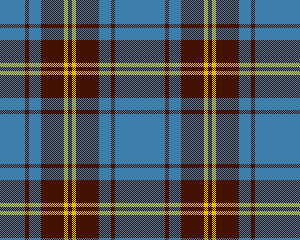
Sligo Tartan
Finally, one might take the view that the relevant County tartan should be based on the county of birth of a clan member or if non-resident in Ireland, the birth county of the last Irish born relative.
In view of the complexities of issues, I would suggest that unless we can discover a clan tartan, that clan members adopt the most relevant tartan to themselves. In any event we set out below the modern County tartans for other counties in which clan members were recorded in the Griffiths valuation of 1846-1865.
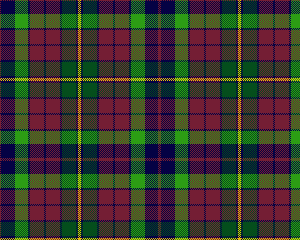
Clare
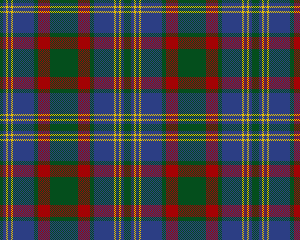
Cork Tartan
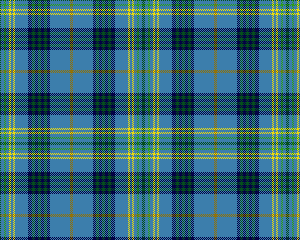
Fermanagh Tartan
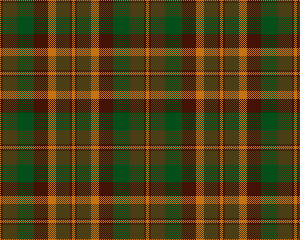
Monaghan Tartan
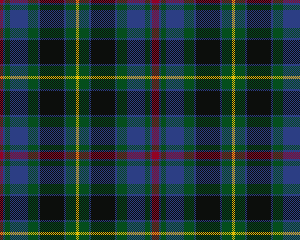
Offaly Tartan

Tipperary Tartan
References
Dunbar, J. Telfer. History of Highland Dress. Philadelphia: Dufour Editions, 1964.
Grimble, Jan. Scottish Clans and Tartans. New York: Tudor Publishing Co., 1973.
McClintock, Henry Foster. Old Irish and Highland Dress. Dundalk: Dundalgan Press, 1943.
Norris, Herbert. Costume and Fashion: The Evolution of European Dress through the Earlier Ages. London: J.M. Dent & Sons, Ltd., 1924.Mairead Dunlevy Dress in Ireland
- Dedicated
Clan Songs and Poems
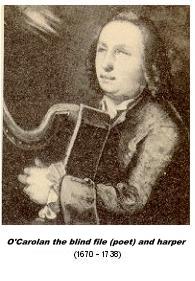
Many Clans have songs or poems which sing the praises of their chiefs and heroes. These poems and the like may have been penned by clan poets or Filí, or by wandering musicians such as the great Ó Cearúlán.
- The
File was of very high status in Gaelic society and the poems he might pen could
either create or destroy a reputation. They were therefore both honoured and
feared in the Gaelic society. A simple phrase therefore such as
"Fáilte uí Cheallaigh" (An O'Kelly's welcome) from the
pen of File was as powerful as the army of any mighty king. (The above phrase
was coined by a file in honour of a particularly generous Munster king and
means welcoming someone with boundless generosity).
We are not aware of such poems or songs connected to the clan, however the name has been associated as a term of abuse which may have a basis in Ireland. This needs to be examined for good or bad. One should realize that several Irish names have become terms of abuse in English. Hence Houligan, Lunny, Loubey, Biddy, Paddy, Mick, Burke, Malarkey etc. Misuse of names and words is not something limited to Irish names. I am sure the reader will be able to devise other terms of abuse which have entered the English language as a result of other colonizations and a variety of reasons.
We have come across a number of more modern snippets which may be of interest. There is the modern Gaelic poet Séamus Ó Maoilearca from Claremorris in County Mayo who has had some work published. From example his poem "Ite Misa est" published in the Gaelic collection "Rogha an Fhile" edited by Eoghan Ó Tuairisc and printed by the Goldsmith Press.
As far as songs are concerned we have also come across a West Indian sea shanty called "The Sailboat 'Malarkey'. The tune and most of the words are from the Bahamas from a singer called Frederick McQueen. The probability is that the shanty was used mainly for boat launching, but may also have been used for other heavy work such as turning the capstan. The main theory is that Malarkey is a mispronunciation of Malachi and if so then has no clan connection. However the words are double edged with double entendre and may have been a scit against a cruel ship owner, or captain called Malarkey. In any event the format of the shanty has a somewhat unusual format, being a full fledged strophic song, two lines of solo interspaced with two lines of chorus, or even four lines of solo and four lines of chorus, rather than the more usual one line and refrain.
"Please tell me what is that sailboat's name?
It's the sailboat 'Malarkey',
Tell me now, what is that good boat's name?
It's the sailboat 'Malarkey'.
Who is that man then that built this good boat?
Richardson, Richardson buil' this fine boat.
Well now, my boys, and we're bound out to sea.
Windward Caroline, come down to me.
She's lovely aloft and she's lovely below,
But she's best on her back, as you very well know.
The blackbird sang and the crow did caw:
Got to set this sail by half past four.
Away, away in St George's Town,
The rats come butting the houses down.
I'd give the world, boys, and all I know,
To turn and roll with my Lucy O.
Pick her up, boys, and lay her down,
And hang on tight as she bounces around.
Oh, tell me what is that sailboat's name?
Tell me, tell me, what is her name?"
Other
We came across the sort of symbol which appeals to this clan member namely a beer called Malarkey's Wild Irish Ale, produced by Portland Brewing in Oregon. This could be worth checking out for anyone in the American North West.

Material Copyright © 2001 Fondúireacht Chlann Uí Mhaelearcaidh